


Author's Note: I wrote this newsletter about the Pope prior to news of his passing. I went back and updated the newsletter to put emphasis on the Pope's call for Christians and Catholics to live in a more Christ-like way.
This Easter weekend, as Christian families gathered in churches, homes, and communities across America, something deeper stirs—something older than our political debates and louder than our partisan fights.
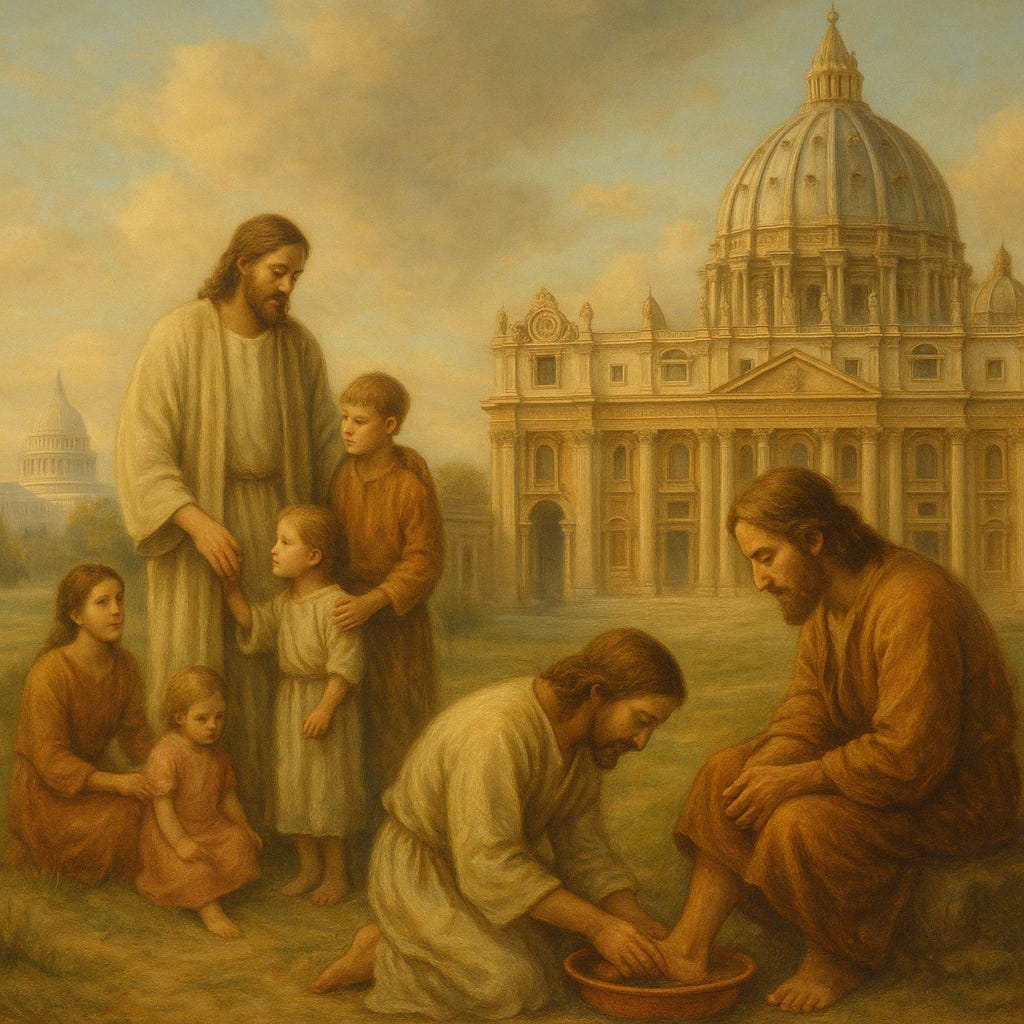
At USTomorrow, we believe the path forward isn’t Left or Right. It’s toward shared values, civic humility, and the moral courage to fix what’s broken. And right now, few things are more broken—and more unifying—than how we treat poverty and how we treat each other.
Poverty doesn’t care if you’re a Democrat or Republican. It cuts across race, religion, and region. It’s as present in rural Appalachia as it is in urban Detroit. And as Matthew Desmond reminds us in his powerful book Poverty, by America, the real scandal isn’t that we can’t solve poverty—it’s that too many benefit from leaving it unsolved.
“Poverty persists,” Desmond says, “not because we lack resources, but because we lack resolve.”
Too often, we label support as “welfare” when it flows down, and “incentive” when it flows up. That double standard reflects deeper values we need to confront. We watched child poverty plummet by 44% during the COVID pandemic—and then let those gains vanish without protest.
We could change all that. But doing so requires something deeper than policy.
It requires virtue.
That’s where Jonathan Rauch’s recent EconTalk conversation strikes a deeper chord. Rauch, a self confessed gay, atheist, Jew and a secular scholar, argues that liberal democracy depends not just on rules, but on moral scaffolding—the kind that once came from churches, synagogues, and civic institutions that taught us humility, compassion, and forbearance.
“Liberalism [think Madisonian liberalism, think small government, free speech, and pluralism—not partisanship] provides a system,” Rauch says. “But it doesn’t provide the values that make the system work.”
We’ve tried to replace those values with performative politics—on the Left and the Right. But outrage isn’t a moral foundation. Algorithms don’t build trust. And when religion becomes thin and sentimental—or sharp and politicized—it fails to teach the virtues democracy needs most.
So what do we do?
We reclaim the thick version of our faith traditions. The one that sees the least among us as sacred. That elevates compromise as a strength, not a sin. That sees government not as a blunt instrument, but as a tool for mercy, justice, and shared purpose.
This weekend, Vice President J.D. Vance visited the Pope—an Appalachian son who grew up in poverty, now sitting across from a global religious leader preaching humility and human dignity. That image, that moment, should remind us what’s possible.
Jonathan Rauch, in his interview with Russ Roberts, makes a powerful plea: our democracy would be stronger if more believing Christians followed more of the teachings of Jesus—especially humility, care for the vulnerable, and forgiveness. At the same time, atheists and secular Americans should grow more comfortable with, and respectful of, those who proudly express their faith and spiritual identity. This kind of mutual forbearance is essential to rebuilding a shared civic culture.
Because this fight is not theoretical.
It’s about the millions of Americans choosing between rent and medicine. It’s about the kid who needs lunch more than rhetoric. And it’s about whether our democracy has the spiritual and moral infrastructure to care—and to act.
The early Christians gathered to lift up the poor, the widow, the outcast. Not as a political act, but as a moral one. It’s time we follow that lead again—not to win the culture war, but to repair the culture of war.
To paraphrase Matthew Desmond: We don’t just need better systems—we need people with the humility and courage to shape them.
Easter is a story of rebirth. We could certainly use a little more of that spirit these days.
Let me know what you think about the role of religion and spirituality in our democracy.
Take care,
Joseph Kopser
Joseph Kopser
Co-Founder of USTomorrow
P.S On a personal note, if you know anyone impacted by cuts or layoffs, or anyone you know looking to transition from one stage in life to another please share with them my post.
As always, if you enjoy this conversation, please forward to friends and encourage them to join on and share their perspective.
I encourage you to click here for more on USTomorrow Blogs, Linkedin , X-Twitter, Instagram, Bluesky, Medium, and Facebook.
Thrilled to stumble across you here!