


I’m back.
Two weeks in the Mediterranean with Amy. It was great. I would like to say it was relaxing, but that’s not usually how I roll. I go hard into the sightseeing. When Amy takes some downtime, I go back out for the things that are only interesting to me (rooftop bars with a great view, military museums, etc…).
Regardless of where we travel, one of my favorite things is people-watching. That does not change whether I’m nerding out in an ancient ruin or watching the inner workings of a little shop from the sidewalk with a beer. I’m always trying to learn something new. And I’m fascinated by what makes people tick.
Today’s newsletter is about three people who have never met each other and are still running the same playbook.
Three thousand feet up a mountain in Montenegro
We came into the port of Bar (yes, that is the city’s name) on a Thursday, and I would guess Bar is not on most folks’ bucket list. Montenegro has only been its own country since a referendum in May 2006, when independence squeaked through at 55.5 percent against a 55 percent threshold, and the century before that is still lurking in the shadows. You drive past buildings that were boarded up a long time ago, past broken glass, and then thirty seconds later you are looking at a stretch of coastline that ought to be famous and somehow isn’t yet.
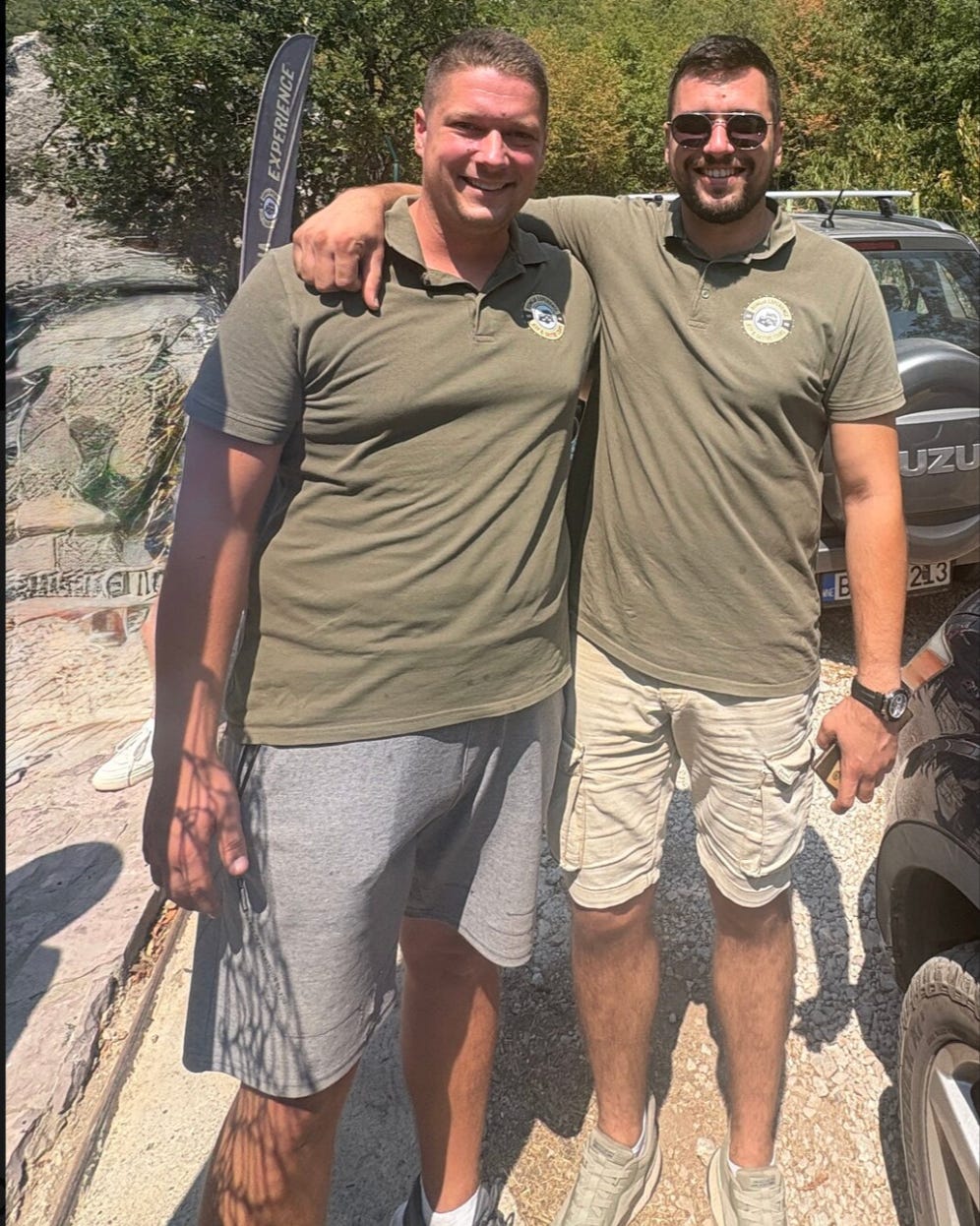
We had hired a car for the day with friends. Our guide was a young guy named Milan, and Milan wasn’t only proud of his country, he actually knew his country well, which is rarer than it ought to be. The history, the arguments about the history, what their identity is trying to become.
He took us to an olive tree first, and I nearly let it go by as scenery.
The Old Olive Tree at Mirovica, just outside Bar, is more than 2,200 years old. It was already a couple of centuries old when the Romans came through, and it was standing about six miles from where a local named Stefan Vojislav ran the Byzantines off in 1042, which is the moment people here point to as the beginning of the idea of Montenegro. (Milan had that whole battle at his fingertips. Dates, names, who switched sides. But I digress.)
It was amazing to realize the olive tree still makes olives. Over 2200 years!
Our last stop was lunch at the mountain house of the man who owns the tour company, three thousand feet up. His name is Drago. Milan is his best friend and stood up in his wedding as his best man, which we found during our ride up and down the cliff side roads of Montenegro.
Drago fed us beef he’d marinated overnight and then slow cooked in a barrel, local wine, local olive oil off that same mountain, and the local moonshine (kinda like grappa).
And of everything I ate and saw that day, the thing I keep coming back to is the bathroom.
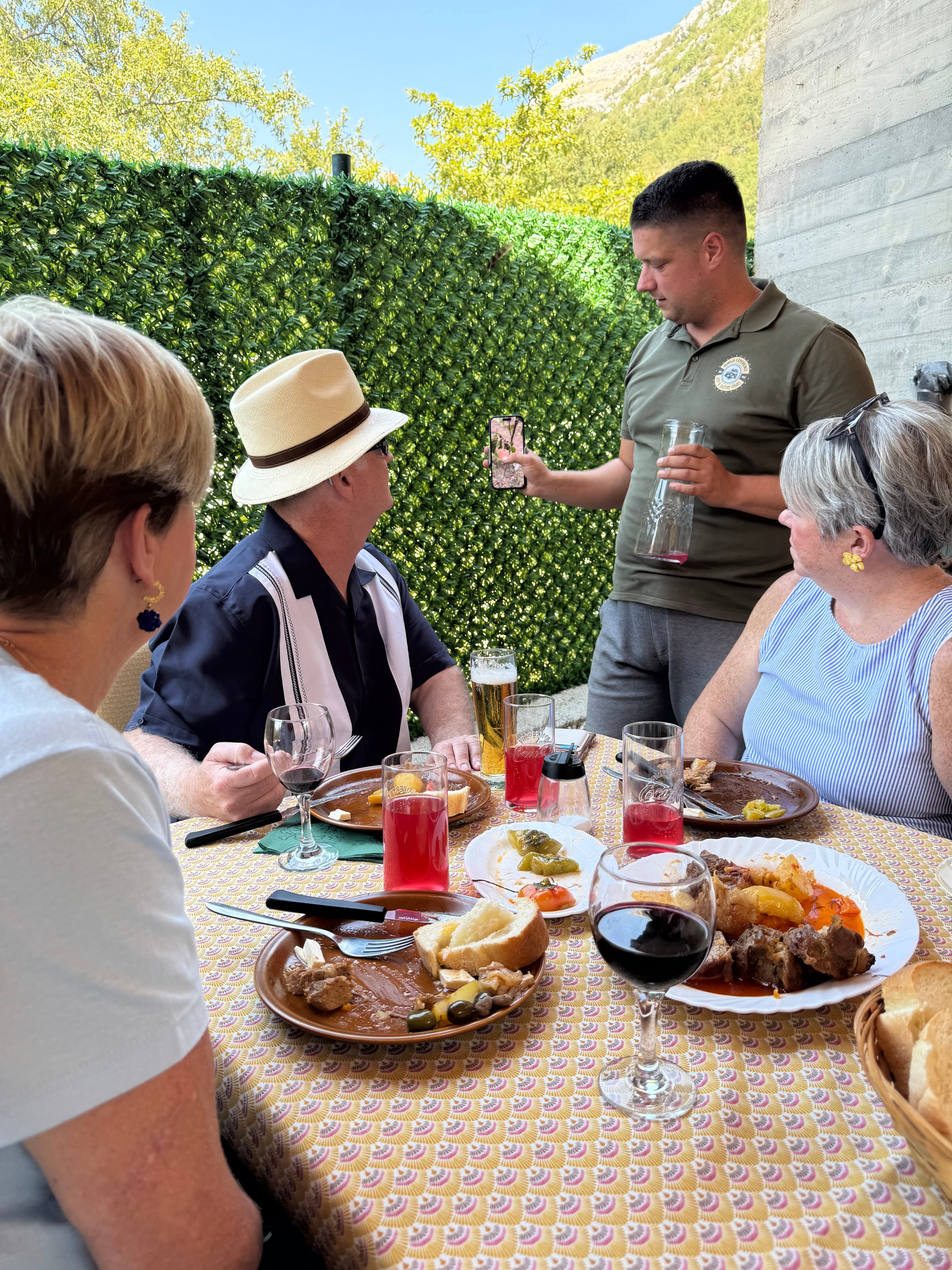
It was spotless. Somebody had thought about it. I know how that sounds, but the bathroom is the part of the experience the customer is never supposed to notice, and thinking about it anyway is the whole job. Drago had thought about the pacing too, and the order the food came out in, and where you sit and what you are looking at while you sit there. Amy and I left blown away. I have paid a great deal more for a great deal less in cities with a concierge in the lobby. Drago knows what he’s doing.
Here is what makes it a business and not just a good afternoon. Drago has a TripAdvisor page, Viator, and GetYourGuide, and a traveler from Canada named Michel left a review three days before we showed up that does the job better than anything I am going to write about him:
Small family/friends enterprise that is starting to grow. Personalized customer service. All the food and wine served is family grown.
A woman from the States named Alison had written back in June that she felt like she was hanging out with friends and getting a true taste of Montenegro, which, having now done it myself, is exactly right. But you can’t teach that! Drago told how he started his “company” but no one came for a year. And when someone did sign up, he learned from their feedack. And got better each time.
So a guy on a mountain in a country of 620,000 people is findable by every cruise passenger who docks in Bar. Talent, plus a review page, and the world comes up the hill to him.
I don’t think Drago is the story, though. I think he is the front end of about nine other stories, and Milan is one of them. Milan and his wife both work in technology and he is angling toward cyber security. When something like Drago’s works in a town like Bar, the next person watching doesn’t have to be talked into believing it is possible, because it just happened down the road from their house.
People will be what they can see.
The same thing was going on in Rome, and then again on the boat
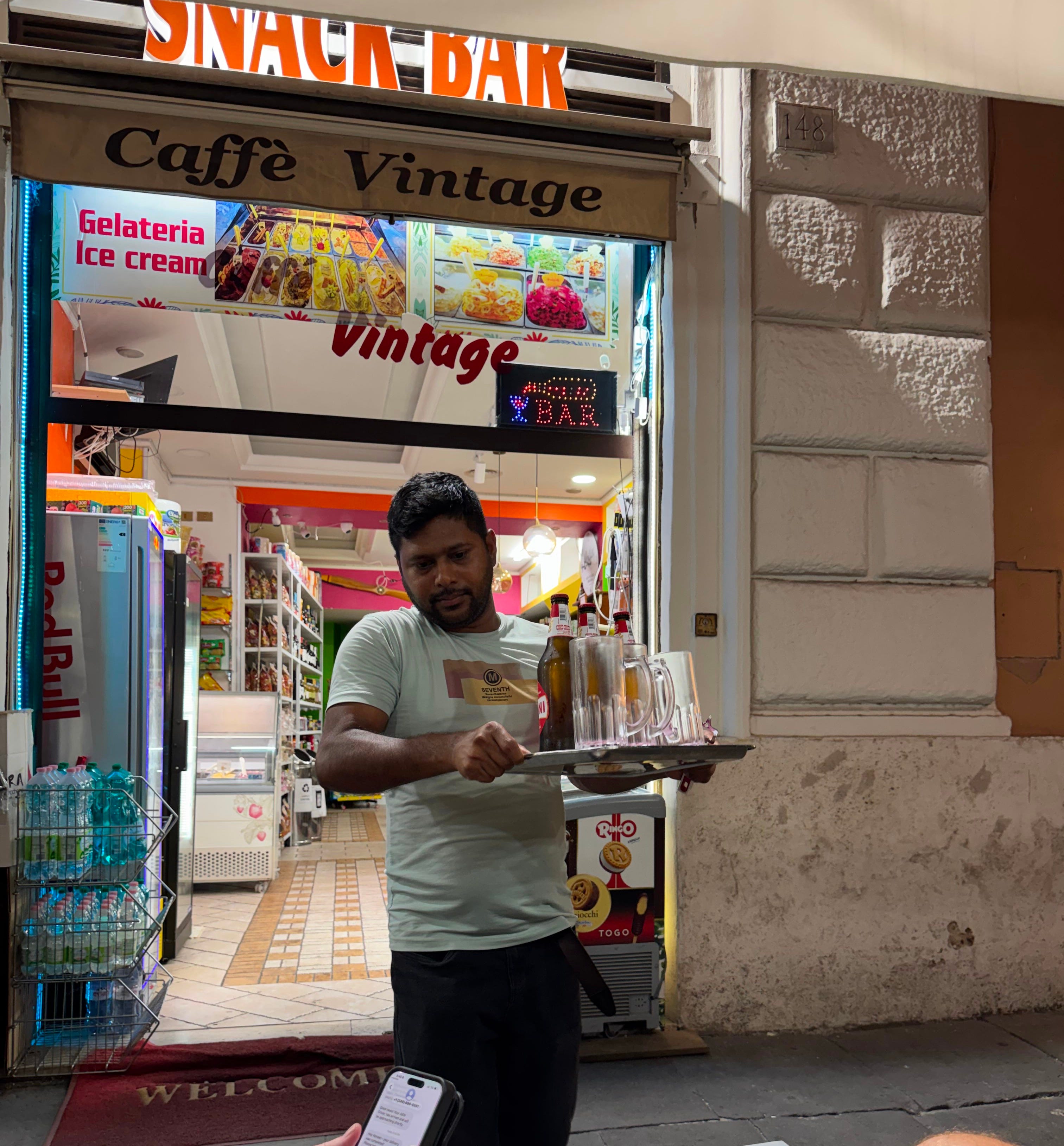
Before we ever got on the ship we had four days in Rome, and around the corner from the hotel was a little shop run by a family that came from Bangladesh.
Three nights running we walked past places that were “fancier” and easier and sat down at theirs instead. Not just for the beer. But for how hard that place worked. Somebody always came out, somebody always took the heavy tray, always a smile, and all of it in a language that wasn’t their first, under a set of rules they had no hand in writing.
Then there was Ash, who worked one of the pool bars.
You can always tell when somebody has that spark. Standing in the sun all day is nobody’s first choice and Ash was clear-eyed about that, but he told us about his village in India, and about a family friend who went off to work on a cruise ship years ago and supported his whole family doing it for a very long time. Ash is doing the same thing now. What he actually wants is to be a sommelier, and he is studying wine the way you study something you fully intend to be good at.
I told him that is a real career and he should go get it. (I hope he does. If he pulls it off I would like to hear about it.)
Every one of them was following somebody
I have been saying the same sentence to audiences for more than twenty years.
People will be what they can see.
What I did not expect was to see it play out so powerfully. Ash had the family friend who went to sea. Drago had somebody who showed him that a lunch on a mountain could be a business. And Drago talked warmly about six months he spent in the United States as an exchange student more than a decade ago, which is the part I haven’t been able to put down since. Same with Milan and his time visting/working in the United States.
Now here is where I had it wrong, and the correction is more interesting than what I believed walking in.
I had Montenegro filed as a place climbing out of a closed, state-run past. Tito, Yugoslavia, all of it. That turns out to be half right at best. Tito broke with Stalin in 1948 and co-founded the Non-Aligned Movement in 1961, and starting in the early sixties Yugoslavia ran the most open borders in the socialist world. Its citizens could travel visa-free across much of Europe at a time when nobody else on that side of the line could. By the mid-1970s more than 800,000 Yugoslavs were working abroad, and by 1980 the money they were sending home ran to something like ten percent of GDP.
So going out and coming back isn’t new here. It is two or three generations old, and Drago’s grandparents could have done it.
What is new is that Drago doesn’t have to leave. He went, he came home, and now the customers come to him, and the whole arrangement runs on a connection, a review page, and a man who thought about his bathroom.
We are in the middle of cutting the thing that does this
Which brings me to the frustrating part. Several people I talked to on this trip were still waiting on visas or had been denied outright.
I don’t know who paid for Drago’s six months here and it never occurred to me to ask him. What I do know is that we have been running exchanges like that for decades, including one built for his part of the world since 2005, out of the State Department’s Bureau of Educational and Cultural Affairs. It is a rounding error in the federal budget, and it is also one of the highest-return things this country does, because a kid who spends a stretch of his youth here spends the next fifty years explaining us to his neighbors, whatever he ends up concluding about us.
The budget request the White House sent up on April 3 would cut that bureau by 68 percent, down to $215 million. It eliminates the Gilman Program and the Stevens Initiative outright and takes Fulbright down by almost 80 percent. Congress has pushed back on this before, and the Alliance for International Exchange has been tracking it the whole way. Last year’s request was a 93 percent cut and appropriators brought it down to about five, and the House has already voted down an amendment to kill Fulbright altogether. But a budget request tells you the intent, and the intent here is to stop doing it.
Look at that as an accounting question rather than a political one. We spend an enormous amount of money trying to persuade the world of things. This is the version that actually works, it costs less than a rounding error on a typical weapons program, and the return shows up thirty years later as a man on a mountain who is glad he came.
We argue constantly in this country about who gets to come in, and some of those questions are genuinely hard, and I am not going to pretend otherwise. But we have gotten so far into the argument that we stopped noticing the benefit. I say it all the time that I wish more people would listen to Reagan’s farewell speech. In it he reminded us of something simple and powerful: you can move to France and never be French. You can move to Japan and never be Japanese. Come here and become an American, and you are an American. That isn’t sentiment. It is our unfair advantage, and it is the one nobody else has figured out how to copy.
Bret Boyd and I put a chapter on demographics and immigration in Catalyst for the unromantic reason that you cannot look honestly at where this country is headed and leave it out. The arithmetic has not gotten friendlier since we wrote it. Birthrate declines in the US will rely on immigrants for decades to come to sustain our economy.
What the three of them have in common
None of them are waiting for permission.
That is the whole of it. Entrepreneurship is not a business plan or a pitch deck, it is somebody deciding to go fix the thing in front of them instead of waiting around for someone else to come do it for them. Drago didn’t wait for Montenegro to finish becoming Montenegro, and the family in Rome didn’t wait to be made welcome, and Ash isn’t sitting by the pool waiting to be discovered.
As they say in Jurassic Park, life finds a way. So do people, when you leave them the room to.
The free flow of information, of ideas, and of people is what made us, and not one of the three keeps flowing on its own just because it always has. That tree above Bar has been making oil for twenty-two centuries through every empire that came through and left again. We have been at this for two hundred and fifty years.
If you ever find yourself in Bar, go up the mountain and find Drago. Tell him I sent you.
So who is it in your town? Tell me about the person, young or old, who demonstrates that hustle.
Joseph
Joseph Kopser
Co-Founder, USTomorrow.us
Joseph Kopser is a lifelong problem solver committed to building the teams needed to take on our toughest challenges. He is currently President of Grayline after he co-founded and served as CEO of RideScout, before it was acquired by Mercedes. He served in the U.S. Army for 20 years earning the Combat Action Badge, Army Ranger Tab and Bronze Star. He is a graduate of West Point with a BS in Aerospace Engineering and also received a Masters from the Harvard Kennedy School and former member of the Army Science Board. He was recognized as a White House Champion of Change for his efforts in Energy and Transportation as well as won the U.S. DOT Data Innovation Award. He co-authored the book, Catalyst, a book focused on helping teams adapt to change. He is the Chair of the Board of Advisors for the CleanTX, an economic development and professional association for energy innovation. In 2025, Joseph was selected for the Texas Business Hall of Fame Future Texas Business Legend Award. Joseph and his wife of 31 years, Amy, live in Austin and they are extremely proud of their three adult daughters living their best lives.
Nice piece, Joseph. Here in Minneapolis, we are privileged to have many immigrants as neighbors, notably Somalis and Hmong among many others. They add spice and drive to our community, and we treasure those. Viva la difference!
My dry cleaner Sam. From Jordan. An engineer there, but couldn't get his license here. Raised two sons who are both engineers here (fully licensed and living their American dream). Sam gives us a music CD every Christmas. A fabric of our community kind of guy who is living his American dream like so many immigrants before him and I hope still to follow.