


A 100-year flood swept Texas last week, but what it revealed about our neighbors may last a century. Here’s what I saw in Sandy Creek—and why it matters for USTomorrow.
While the headlines understandably focused on Kerr County’s tragic loss of life, I spent a day in a quieter corner of Northwest Travis County—Sandy Creek—where Mother Nature was no kinder. What I witnessed there reminded me why, even in crisis, the American spirit still shines.
1. In the Face of Nature, the American Spirit Shines Bright
When I arrived, Round Mountain Baptist Church had been transformed into a military style command-and-control post I’m used to in the Army but this CP was populated by civilians in all manners of “uniform,” from all walks of life, and in that terrible moment, without political affiliation. The scene took me straight back to military days: whiteboards filling up with task lists, volunteers forming quick-reaction teams, radios crackling, cases of water stacked high on pallets. Nobody was shouting orders; people simply sorted themselves out—just as Alexis de Tocqueville marveled in the 1830s when he described how Americans band together and form groups often before government officials can even arrive (fortunately for us, Travis County and Texas TDEM were already on site helping by Monday). Applied to our modern political landscape, I can't help but wonder if a crisis moment is the catalyst to leave the divisive nature of modern politics behind.
2. From Barn-Raising to Chain-Saws—Collective Care, Texas-Style
Within minutes of being sorted and dispatched, we were walking among debris strewn about the lawn at a house along the creek. Chainsaws buzzed, sawdust shot everywhere, strangers exchanged first names, and a human assembly line hauled tree trunks, microwaves, and even an entire kitchen sink into towering piles. My smartwatch later told me I’d logged 12,000 steps without ever leaving the yard.
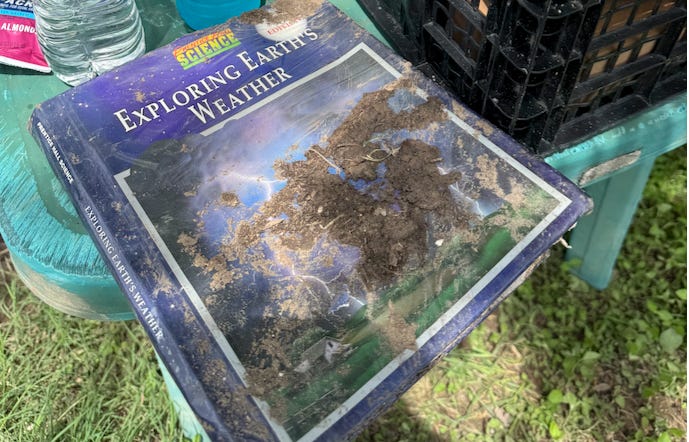
Small victories kept us going: a mud-caked oscilloscope that once belonged to the owner's grandfather to tune his instruments, a wedding photo album we hope finds its couple, and—most ironic—a mud covered textbook titled Exploring Earth’s Weather.
3. Social Capital Lives (Robert Putnam Was Right)
Putnam’s Bowling Alone charts the long decline of American community life, but on that day in Sandy Creek, the spirit underlying the American community came to life. Confusion was high, the Texas heat higher, but tempers stayed low. Patience, humor, and a simple can-do mindset ruled the day while leaders built systems on the fly. This is the “upswing” Putnam writes about—the moment we choose “we” over “me,” put boiling politics on a back burner, and allow unfettered goodwill to deliver the progress we all have the potential to provide.
4. Building a Better U.S. Tomorrow
During this latest calamity, whether you gave time (12,000-step days), talent (a chainsaw and know-how), or treasure (online donations), professional and volunteer frontline Americans (and crews from nearby Mexico) proved once again that political division shrinks in the shadow of real need. If we keep that same energy for the slow, quiet work of rebuilding—long after TV crews pack up—we can, in Tocqueville’s words, “bring forth wonders.”
Call to Action
Virtually every Texan has been impacted by this catastrophic series of events. Think about one neighbor, nonprofit, or local team still deep in cleanup mode. Shoot them a text, Venmo them lunch, or just show up with work gloves. The higher angels we saw last week don’t need a natural disaster to go to work. It's critical that we don't let their example or the lessons these challenges provide slip by unheeded.
Let me know of any extraordinary examples of “we before me” you've seen out there. Many of these will be heartbreaking, but, without exception, worth our attention, appreciation, and consideration of how to apply that dedication to our own roles.
Take care,
Joseph

Joseph,Thanks for reminding us with your ‘we over me’ example-a lesson for adults and their families too.
Carol Thompson