


To all my fellow American’s thinking of joining immigration protests this weekend in response to the White House’s recent actions, I want to offer a different perspective.
Yes, you absolutely have a First Amendment right to protest—and if you’re set on doing that, you may not need to read much further. But if you’re open to considering another approach, I’d ask for a few minutes of your time.
Like most things in life—whether it’s business, politics, or personal decisions—it's important to start with the end in mind. What outcome are you hoping to achieve by protesting?
In a perfect world, a peaceful, coast-to-coast demonstration of support for more humane immigration policy could move the needle. I wish that were the case. But I live in the world we’ve got—not the one I wish we had.
The hard truth is that more Americans voted for Donald Trump than didn’t because of his stated immigration policy, not in spite of it. From the day he descended that escalator, he made it clear: he intended to fulfill his campaign promise to your fellow citizens to remove undocumented individuals from the country. And millions supported him for it. More voted for it than against.
So if your goal is to change immigration policy, the only path forward is to change the laws. And to change the laws, you have to change the lawmakers. And that means changing minds—and votes.
Here’s the problem: footage from the recent protests in Los Angeles—especially the violent scenes involving Molotov cocktails and property damage—isn’t changing minds. Even though peaceful protesters vastly outnumber the violent few, the media spotlight amplifies the chaos. As the LA County District Attorney noted, 400 violent agitators out of 4 million residents make up 0.01% of the population, yet dominate 100% of the news cycle.
Those images aren’t creating sympathy. They’re reinforcing the administration’s narrative that only it can restore order to a nation in decline.
The reality? Those causing the violence may not even care about immigration. Some just want to throw rocks, damage property, or provoke police. And while peaceful protesters may have good intentions, they’re providing cover for chaos—and that undercuts the message. They are literally using your peaceful protest for cover to cause chaos— which fuels the other side of chaos into a vicious downward spiral in which no one wins.
So if protesting won’t work, what will?
Try a Two-Front Strategy Instead:
Support Immigrant Families Directly
Find the families most affected right now—those afraid to go to work or send their kids to school. Partner with groups like Catholic Charities or local mutual aid organizations. Bring meals. Offer childcare. Show up in real ways.Let the Consequences Play Out Publicly
Let the nation see what happens when ICE raids farms, construction sites, hotels, and factories. Let people witness the real economic cost—rotting crops, stalled housing developments, and absent caregivers. When the disruption reaches everyday life—when housekeepers, landscapers, and nannies stop showing up—only then might public opinion begin to shift.And only then might store owners and business leaders start calling their elected officials, demanding a more practical and humane solution.
Let the images of U.S. Soldiers and Marines sleeping on warehouse floors without proper support circulate widely. Let those who voted for these policies reflect on whether there’s a better, more responsible way forward—one that keeps the end goal in sight.
This is the uncomfortable truth: for decades, lawmakers—Republicans and Democrats alike—allowed this underground economy to flourish. Why? Because cheap labor benefited industries, households, and consumers alike.
But now we all have to reckon with the cost. Deportation on this scale is expensive, and Jason Calacanis recently laid out what that will mean: billions spent on enforcement, incarceration, and deportation—all passed on to taxpayers. And when those jobs are filled again, wages will go up. Which means prices will go up.
We also have to reckon with the reality that millions of naturalized citizens did come here through the system and spent lots of money to earn their citizenship and shake there head to wonder why Democrats would allow stores to be looted in the name of protecting workers who lived here undocumented outside of the system they worked are to follow the rules established.
So ask yourself:
Do we want to pay to rebuild cities after riots?
Do we want to fund National Guard deployments to keep streets calm?
Or would we rather use that money to support families, stabilize communities, and work toward long-term solutions?
It took decades to create this mess. It won’t be fixed in a weekend.
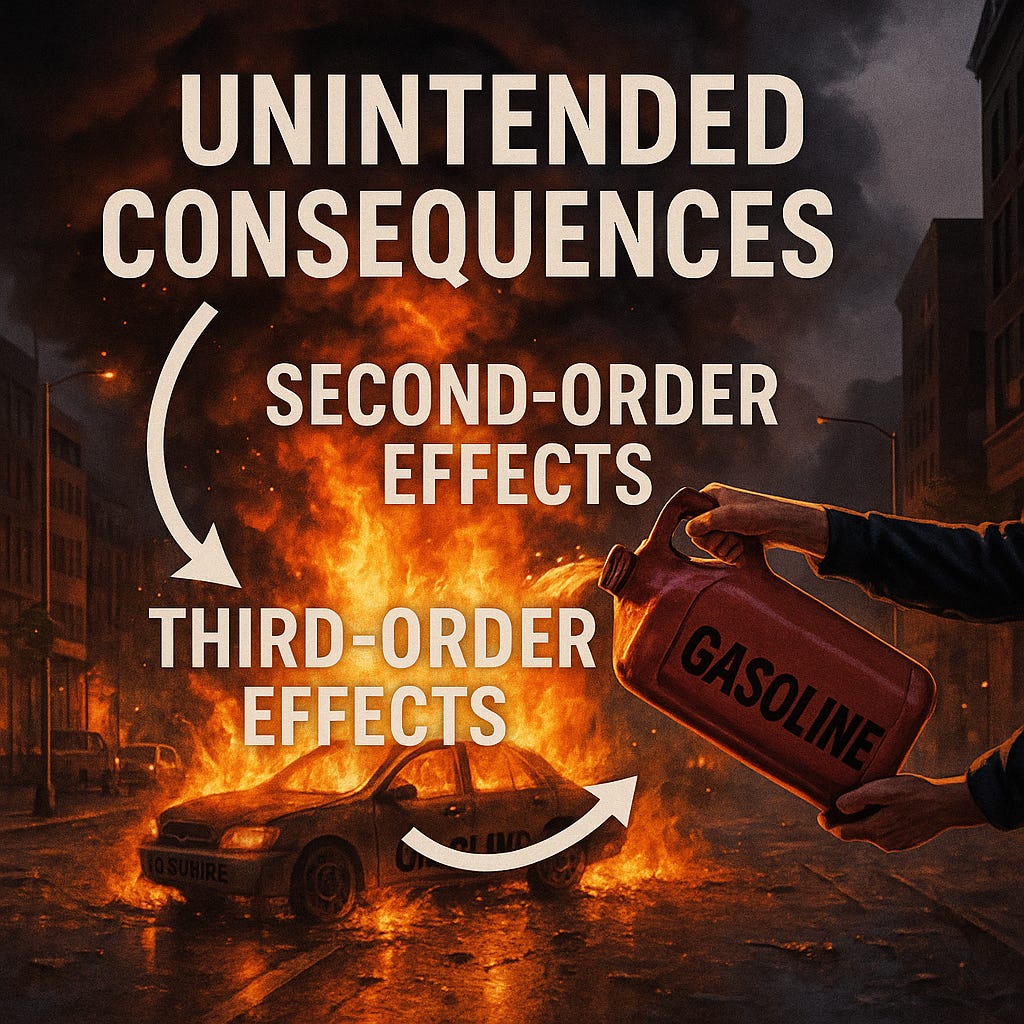
So to my friends who plan to protest this weekend: you have every right to be heard. Just don’t forget to consider the second- and third-order consequences. You might be playing right into a script written by someone who doesn’t share your values or your goals. There could be other ways to achieve your goals.
And those paths go through the ballot box at some point.
Joseph
Joseph Kopser
Co-Founder of USTomorrow
Sir,
I believe you underestimate the mental bandwidth of a substantial number of the American public. I am in a major metropolitan area where the vast majority of people have objected to Trump's actions to dismantle our republic since January 21, long before the illegal immigration raids began. Hence the name "NoKings" Many of us are well aware that the program the administration is following to transform our nation has a short timetable. We cannot wait for the ballot box. We are demonstrating NOW to remind those on Capitol Hill, at 1600 Pennsylvania Ave, and at the Pentagon that "We, the People" have read the Declaration of Independence and the Constitution. We expect ALL of them to honor the oath they took when they signed on to "preserve, protect, and defend THE CONSTITUTION OF THE UNITED STATES OF AMERICA.
Oh, the majority of Americans who voted in 2024 did NOT vote for Donald Trump. His total was less than 50%