


You are seeing it all over the news so I thought it was worth a deep dive as its something I follow closely as a member of CleanTX. A five-person board in a small Michigan town voted 4-1 to reject a rezoning request for a $500 billion AI campus backed by OpenAI and Oracle. Two days later, the developer sued the township. Within weeks, construction equipment was on the site anyway, moving under a state permitting path that didn’t require the township’s blessing.
That story is going to repeat itself in towns and counties across this country. A March Gallup poll found that 71% of Americans now oppose building AI-supporting data centers near them. I have not seen public sentiment swing that hard against a piece of physical infrastructure in a long time.
So before the country splits into “data center yes” and “data center no” camps and stops talking to each other, I want to lay out how I’m thinking about this. Because if we get the debate wrong, we lose more than we know.
Start with what change actually is
In the opening chapter of Catalyst: Leadership and Strategy in a Changing World, my co-author Bret Boyd and I spend the whole first chapter on one question: what is change, really?
Not innovation. That’s the easy part. Change is what happens to everyone around the innovation. It’s the disruption to a town’s tax base, a worker’s identity, a homeowner’s view out the kitchen window, a utility’s load forecast. Innovation is a press release. Change is a fight.
Every wave of new technology runs into the same pattern. The people closest to the disruption push back first and loudest, and they are often right about the specific harms they see. But the question is never “is this disruption uncomfortable?” Of course it is. The question is whether we shape it together or let it happen to us.
Data centers are this generation’s test of that question.
The closest parallel: fracking
If you want to know how this story plays out, look back about fifteen years.
Hydraulic fracturing wasn’t a new idea in 2010. The basic technique dated to the 1940s. What changed was that horizontal drilling and modern fracking finally made it economic at scale. The early days were chaotic. There were real environmental problems. There were towns that voted it down, lawsuits, documentaries, kitchen sinks lighting on fire on YouTube. A lot of the concern was legitimate.
Then look at what happened. In 2005, the U.S. was importing about 15% of the natural gas it consumed and building LNG import terminals because we were sure we’d run short. By 2017 we were a net exporter. By 2023 we were the world’s number one LNG exporter, ahead of Qatar and Australia. Cheap domestic natural gas displaced a huge amount of coal, which, whatever you think of fossil fuels, was the single biggest driver of falling U.S. carbon emissions in the 2010s. (I highly encourage Michael Webber work that you can find here. His documentary goes deep into the story of energy.)
Fracking wasn’t harmless. I am not arguing that. But on the net, over the long arc, fracking did more good than harm for American energy, American manufacturing, and American geopolitical leverage. The people who screamed loudest in 2010 weren’t wrong that there were problems. They were wrong about the shape of the future.
AI data centers are the same shape of story. We’ve had data centers for decades. Every credit card swipe runs through one. What’s different now is that modern AI models have a voracious appetite for compute, and that compute requires new chips, larger campuses, and a frankly mind-boggling amount of power and water. U.S. data center electricity demand is projected to nearly double from roughly 80 GW today to 150 GW by 2028, and to consume about 12% of all U.S. electricity by 2028. A typical 100 MW AI campus drinks 1.5 to 3 million cubic meters of water per year for cooling.
Those numbers are real. The concerns are real. And just like fracking in 2010, they’re getting tangled up with something else.
Two kinds of “no”
When I read about a town meeting where a data center package gets voted down, I try hard to separate two very different groups of people standing at the same microphone.
The first group are neighbors and ratepayers genuinely worried about water tables, electric bills, traffic, and the night sky. Those are not unreasonable things to worry about. We should listen.
The second group are people with an ulterior motive. Folks who don’t actually want the digital economy to scale at all, or who are using local zoning as a proxy fight for a much bigger argument about technology itself. (Keep an eye on the Chinese or Russians messing with our social media influecning this political debate because they do not want the Americans to win the AI race). I see those two groups getting looped together, and the result is that the legitimate concerns of the first group never get answered, because the political energy gets captured by the second.
I’ll also say what is true about the other side. The hyperscalers and tech giants building these campuses have not, historically, been great citizens at the local level. They show up with lawyers and tax-abatement asks before they show up with listening sessions (some are better than others with community outreach! My friend Jose Beceiro is a great example). Some of them pour money into political causes that run directly counter to my own beliefs. They have earned a chunk of the suspicion they’re getting. They need to do dramatically better as stewards of the communities they enter and the watersheds they tap.
But “the developers have behaved badly” is not the same as “the infrastructure shouldn’t exist.”
The silver lining that few are talking about
Here’s the part that gets me genuinely excited, and I don’t think it’s getting enough airtime.
If we structure the incentives correctly, the private sector building this AI infrastructure is about to fund the biggest acceleration in new energy production, storage, and distribution in modern American history. Hyperscalers are signing power purchase agreements for new nuclear. They are restarting Three Mile Island. They are building behind-the-meter gas-plus-renewables, deploying batteries at unprecedented scale, and quietly pioneering microgrid campuses.
Picture a data center campus that is also a community microgrid. Generation, storage, and load on one site, with the spillover used to stabilize the regional grid and, in some scenarios, deliver heavily subsidized or near-free electricity to the surrounding community. That is not science fiction. That is a structure we can negotiate for, if local governments come to the table understanding what leverage they actually hold.
The communities that say “no, never” miss that leverage entirely. The communities that say “yes, but here’s what we want in return” are about to write themselves a generation of upside.
And then there’s China
I don’t bring up China to wave a flag. I bring it up because the math is the math.
China is on track for roughly 400 GW of spare power capacity by 2030. That’s about triple the projected power demand of the entire global data center fleet. In the first half of 2025 alone, China installed 357 GW of new wind and solar, more than the entire installed power capacity of India. Chinese data centers pay less than half of what American ones pay for electricity, and a project there moves from plan to operation in months rather than years.
Meanwhile, nearly half of planned U.S. data center builds for 2026 have been delayed or canceled. Power shortages. Transformer backlogs. Local opposition. Permitting purgatory.
If we lose this round, the country that wins it is one that does not recognize the rights of its own people, does not have a free press, and does not subject its decisions to the consent of the governed. I am not willing to hand that government compounding leadership over the most important general-purpose technology of our lifetimes because we couldn’t figure out how to talk to each other about a 200-acre campus in our county.
We’ve seen this movie
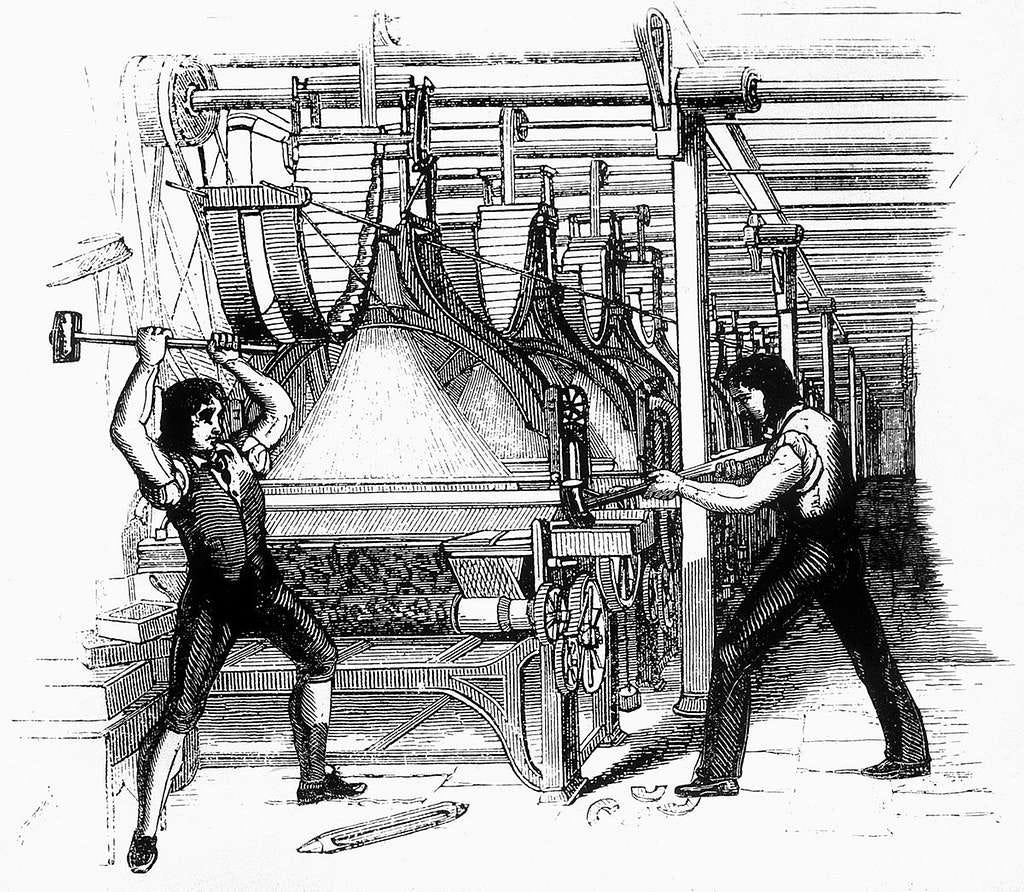
In the early days of the Industrial Revolution, Luddite weavers smashed the looms because they were certain the machines were coming for their livelihoods. They were, in a narrow sense, right. And in the longer sense, no industrial society since has ever willingly gone back. The looms won. The question was always whether we would build the schools, the safety nets, and the new jobs fast enough to bring the people forward with the technology.
That’s the same question on every college campus where students boo speakers who want to talk honestly about AI. I get the fear. I also know that booing the conversation off the stage doesn’t make the technology go away. It just guarantees that the people who do show up to shape it don’t look like you.
A few months ago I had a long conversation with my friend Brett Hurt, founder of data.world and one of the clearest thinkers I know on the ethics and architecture of AI. We spent most of it on a single point. The potential of this technology, properly harnessed, is staggering. The risk isn’t that AI gets built. The risk is that it gets built somewhere we don’t have a say in how.
What I’m asking of you
I know this is not the most popular position to take with the US Tomorrow audience. Push back. That’s the point of this newsletter.
But before you vote no at the next zoning meeting, I’d ask four things.
Replace “yes or no” with “yes, and what do we get?” Demand water reuse, grid contribution, ratepayer protection, workforce pipelines, and a local tax structure that actually funds schools. The leverage is real.
Insist on public-private partnerships. Private capital, nonprofit accountability, workforce-development institutions, and local voters at the same table. Not separate tables.
Hold hyperscalers to a higher standard of citizenship. Make community stewardship a precondition, not a press release.
Don’t let the loudest voice in the room speak for the whole town. The folks with ulterior motives are organized. The folks who just want a fair deal need to be more organized.
We’ve done bigger things together than this. The interstate highway system. Rural electrification. The internet itself. Each one came with real, painful disruption. Each one paid back the country many times over because we decided to shape the build instead of refusing it.
The looms are coming either way. Let’s be the country that owns them.
— Joseph
Co-Founder of USTomorrow
Catalyst: Leadership and Strategy in a Changing World, co-authored with Bret Boyd, is available wherever books are sold. The first chapter is the foundation for how I think about everything in this piece
Joseph Kopser is a serial entrepreneur and leadership development expert. Prior to that his company, RideScout, was acquired by Mercedes. He served in the Army for 20 years after graduating from West Point and Harvard. He was recognized as a White House Champion of Change in clean energy and won the U.S. DOT Data Innovation Award. Co-author of Catalyst: Leadership and Strategy in a Changing World, co-authored with Bret Boyd, is available wherever books are sold.
Adding this update from ChatGPT about China's potential influence: https://www.politico.com/news/2026/06/10/openai-china-ai-data-centers-report-00957612
https://fortune.com/2026/09/18/ai-data-centers-stranded-assets-silicon-belt/
The above is a side of the issue no one is talking about!