


Thank goodness my dad recorded our childhood. Lots of pictures too.
That’s me in the red tank top, with the blond hair I still miss, pedaling a bicycle wrapped in red, white, and blue streamers down a street in our neighborhood. The little one on the Big Wheel is my sister Jennifer. The date is July 4, 1976. America’s 200th birthday.
For as long as I can remember, love of country and the Fourth of July have been the same thing to me. I owe a lot of that to my father, who did something rare for the 1970s: he not only took the pictures, he shot the home movies. This week, with the country about to turn 250, I went digging through eleven gigabytes of his movies and found this two minute clip of my sister and me riding in the Bicentennial parade.
More than any flag or firework, that clip is what the Fourth has always been to me. It is the one day on the calendar built to bring all of us together for love of country.
Every kid in America was in that parade (so I thought)
If you were a kid in 1976, you remember. The fire hydrants painted like minutemen. The Bicentennial quarter with the drummer boy on the back. Red, white, and blue on cereal boxes, gas stations, and garbage trucks.
And we were organized. It was our parents who pulled it off, especially the moms, like mine, pushing my sister up the hill on her Big Wheel when the climb got too steep for a three year old’s little legs. The whole street turned into the parade.
Here’s what I didn’t understand at five years old. The magic wasn’t the decorations. The magic was that everybody showed up to the same party at the same time. I write about this constantly now: the bonds, the norms, and the trust we build simply by being in the same place together, especially between neighbors. Scholars call it social capital, and it is one of the most important, and most fragile, elements of the human experience.
And it wasn’t that we had no other options. It was that everybody was so excited about the 200th birthday that they showed up anyway. You could see it in the sheer mob of kids on bikes. Most everyone showed up, and everyone showed out.
Trading the Bike for the Uniform
That feeling of patriotism, riding down the street on my red, white, and blue bicycle, is the same feeling I got to trade up for thirteen years later, when I swapped the bike for the chance to wear my country’s uniform. I reported to West Point for R-Day on June 28, 1989, and spent that Fourth of July less than a week into Beast Barracks, with a fresh haircut and a new salute, alongside a thousand other kids who had watched the same Bicentennial from their own bikes in their own hometowns.
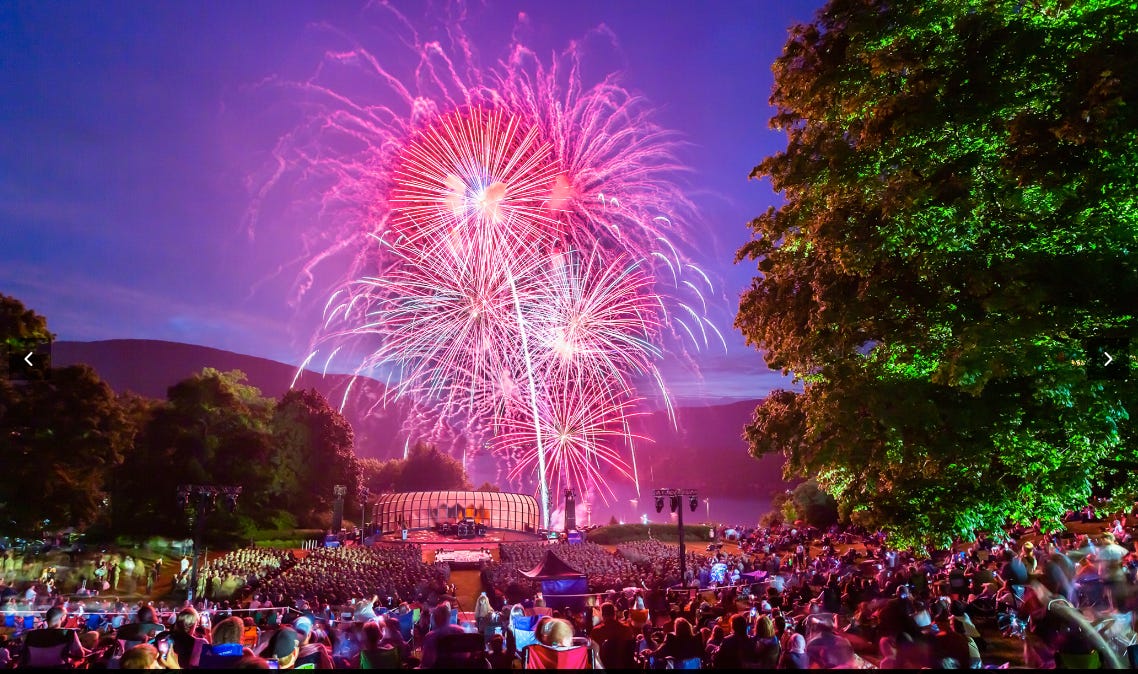
Different parade, same pride. Whether I was on that bicycle in Kentucky or standing in formation in Cadet Gray, I felt the same two things I still feel every Fourth: pride in my country, and the deeper pride of being part of something much larger than myself.
The Fourth of July with no children
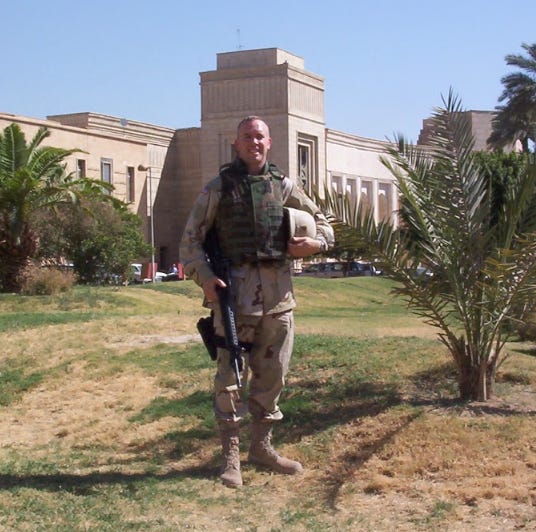
Fifteen years after that, on July 4, 2004, I was a Major at Saddam’s former Presidential Palace in Baghdad, sent there to help plan Iraq’s national elections. The 1st Cavalry Division band came down and set up by the pool. I wrote home about it that summer, in an e-mail diary that later ran in West Point’s Assembly magazine, and I’ve never been able to say it better than I did then:
The longer I sat there looking at all the contradictions, something seemed very out of place. We had American flags, patriotic music, a swimming pool, and ice cream—and some had beer. The only thing missing was children. I had never been to anything 4th-of-July-related without kids running everywhere. There was no one there to hold tightly and reassure as the fireworks boomed overhead, no one who would stare wildly into the sparklers as they lit up their face. There were plenty of people—but no one who really matters to me. Bittersweet. A holiday event I will never forget, but one I never hope to repeat.
That day in Baghdad taught me what the holiday actually is: the kids under the flags.
Why can’t you be a Republican?
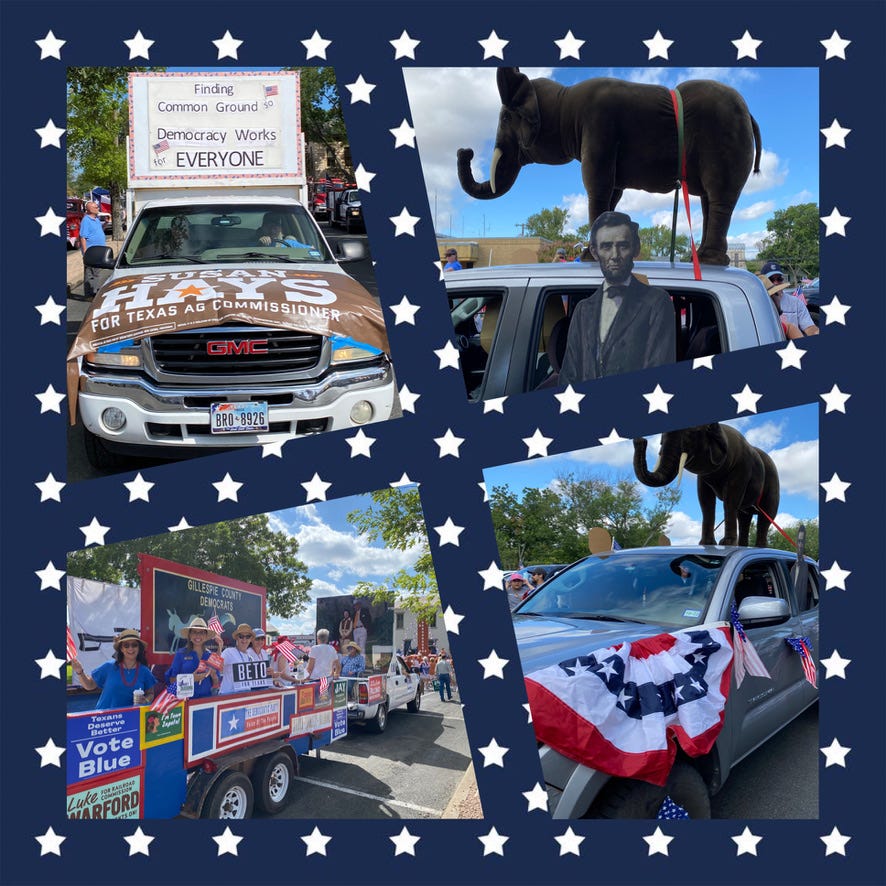
By 2018 I was back in a Fourth of July parade myself, this time in Central Texas, running for Congress. Before the parade stepped off, I was in the staging area and wandered over to say hello to the folks on the Republican float. They had a great time giving me a hard time, and we went back and forth on the issues, all in good humor. What I loved most was that most of my answers landed far more in the center, far closer to where everyday people actually live, than anyone expected. I think it caught a few of them off guard. They were not quite ready for a former Republican, Combat Vet, businessman running as a Democrat.
But here is my favorite moment of the whole day. As I was walking away, one nice little old lady called my name and waved me back over to the GOP float. She pulled me in close to whisper in my ear.
“Why can’t you be a Republican?”
I loved her for that question. Not because of the party, but because she asked it sincerely, and a little distraught, having just realized in real time that she had been putting party over country, choosing a line on the ballot instead of choosing the candidate standing in front of her. I told her what I still believe. Service to your country in uniform, and service to your country in business, are not Republican values or Democratic values. They are American values. On that day, the 4th of July.
The same curb
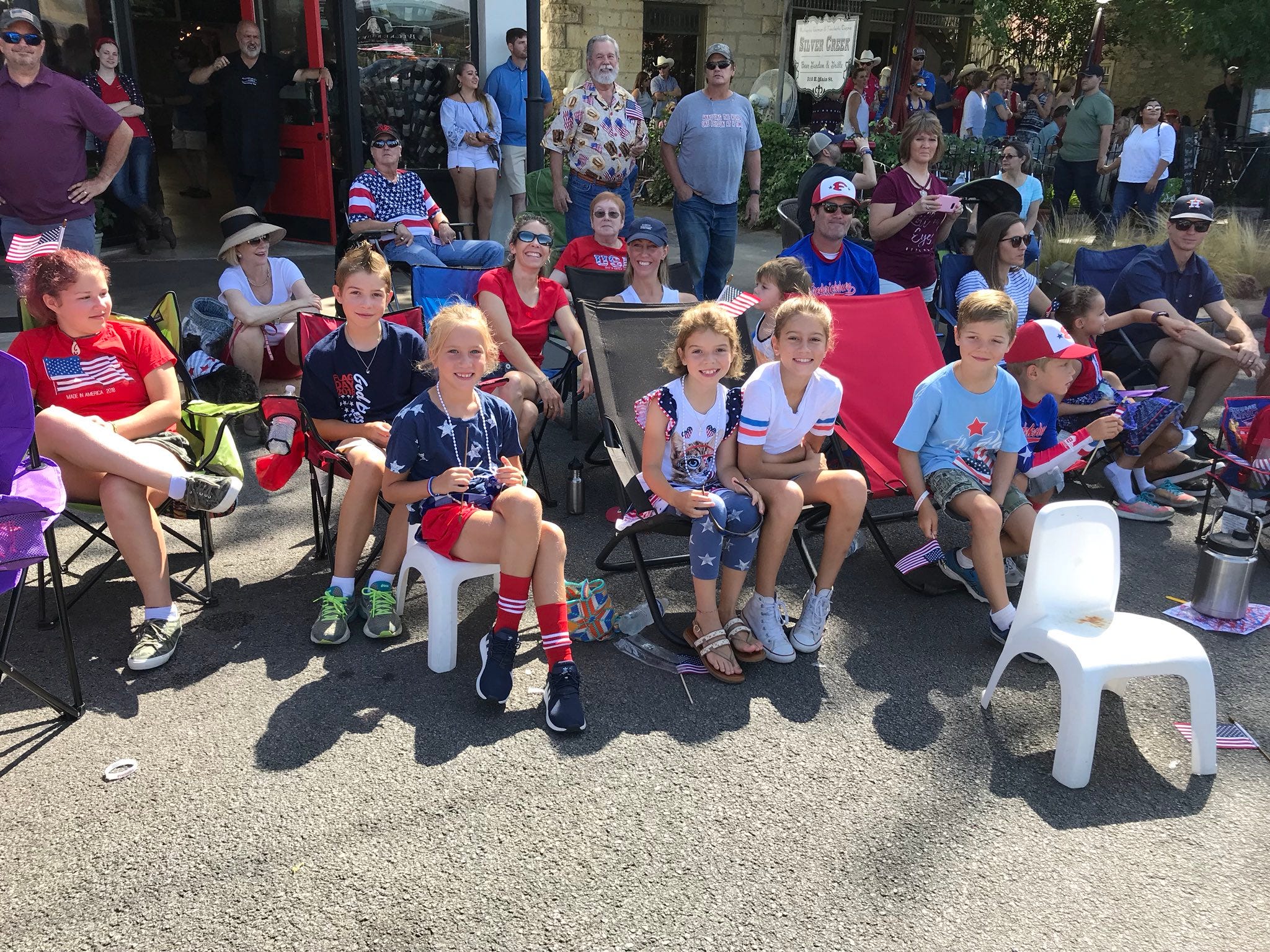
Two years later, at a small town Fourth of July parade in the Hill Country, I took my favorite photograph of the whole fifty years. The Republican float rolled by with a stuffed elephant and a cutout of Abraham Lincoln riding on a pickup. A few minutes later the Democratic float came down the same street. The same families waved at both from the same curb, and everybody’s kids chased the same candy. I captioned it that day: finding common ground, because democracy works for everyone.
The full suit
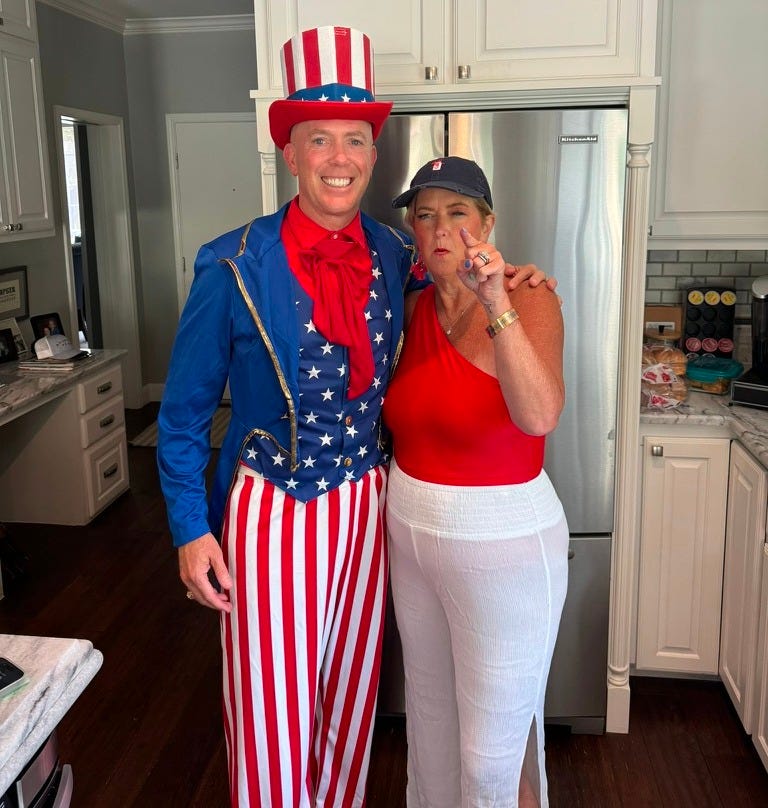
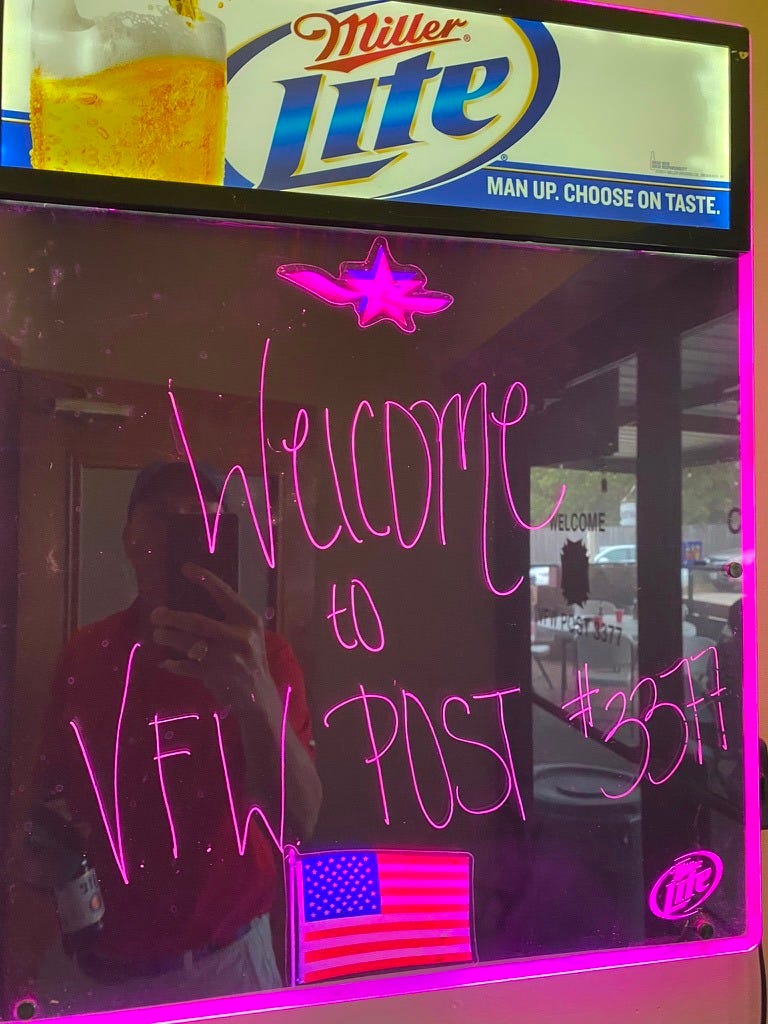
By 2024 I had leaned all the way in. The Uncle Sam hat had grown into the full suit: stars, stripes, tailcoat, the works. Amy maintains I’m not allowed to wear it to dinner parties. The jury is still out on the 250th. I wore it to VFW Post 3377, where we’ve now spent our last several Fourths, three generations of family around one table, next to veterans who have their own Baghdads to remember.
What the 250th is really for
I’ve written before about whether the truths we celebrate on this day are still self evident. Last year I answered: maybe. That answer hasn’t changed.
In the Pursuit of Happiness

This July 4th, I'm reflecting not just on our independence from a king, but on the independence so many of us crave today—from dysfunction, division, and performative politics.
But fifty years of my family’s Julys keep teaching me something simpler. At the end of the day, the Fourth of July should be the one great holiday that still brings all of us together. It is the day that reminds us of the child in every one of us. Whether that child grew up riding a red, white, and blue bicycle in a neighborhood parade, or is a kid on the other side of the world right now, on this very Fourth of July, dreaming of one day moving to the United States to build a better life.
We’ve gone from three channels to infinite channels, from one neighborhood parade to a thousand personalized feeds. The Fourth of July parade is one of the last things left that the whole country can still do at the same time, together. You can’t stream it. You have to stand on the curb next to people who didn’t vote the way you did, while your kids chase the same candy.
So here’s my one ask for America’s 250th birthday. Go to the parade. Stand on the curb. Bring a kid, yours or a neighbor’s. See it through their eyes. Long before they can see political division.
And somewhere in that pack of bikes and Big Wheels is a five year old who’ll be telling this story at the 300th. (This particular former 5 year old will be 105 years old).
Amy and I wish you and your family a joyful Fourth. Take care of each other out there.
Take care,
Joseph
Joseph Kopser
CEO, USTomorrow.us
P.S. I want to see your archives too. What do you remember about July 4, 1976? If you weren’t born yet, what’s your first Fourth of July memory? Leave a comment, or hit reply if you’ve got a photo. I read every one.
Joseph Kopser is a lifelong problem solver committed to building the teams needed to take on our toughest challenges. He is currently President of Grayline after he co-founded and served as CEO of RideScout, before it was acquired by Mercedes. He served in the U.S. Army for 20 years earning the Combat Action Badge, Army Ranger Tab and Bronze Star. He is a graduate of West Point with a BS in Aerospace Engineering and also received a Masters from the Harvard Kennedy School and former member of the Army Science Board. He was recognized as a White House Champion of Change for his efforts in Energy and Transportation as well as won the U.S. DOT Data Innovation Award. He co-authored the book, Catalyst, a book focused on helping teams adapt to change. He is the Chair of the Board of Advisors for the CleanTX, an economic development and professional association for energy innovation. In 2025, Joseph was selected for the Texas Business Hall of Fame Future Texas Business Legend Award. Joseph and his wife of 31 years, Amy, live in Austin and they are extremely proud of their three adult daughters living their best lives.
Wear the suit on the 250th. You've earned it.