


The Center Isn’t Mushy — It’s the Rudder
What happens when elections become instruments of revenge instead of renewal? In this week’s USTomorrow, I argue that America’s next chapter only works if it’s anchored in the center—and I show why the data backs it up.
1) A Thought Experiment for a Hyperpolarized Moment
Close your eyes and imagine the next president—whoever it is—taking office with one goal: payback.
Every lever of power is trained not on public service but on political enemies. Investigations become weapons. Appointments become loyalty tests. The bureaucracy is purged and rebuilt to reward friends and punish opponents. The other side, seeing this, vows to do the same when they win it back—and the pendulum swings wider, faster, and meaner.
That cycle doesn’t end in a stronger America. It ends in brittle institutions, a demoralized civil service, and a public that stops believing the rules apply to everyone. I’ve seen versions of this dynamic abroad in my military service around the world and studied it at home: once politics becomes retribution, governing becomes impossible.
My thesis: The next chapter of American leadership has to be moored at the center—not the status-quo center that avoids hard choices, but the anchoring center that keeps the ship from lurching hard to port or starboard (left or right for my fellow Army folks) with each election. The center is ballast, not boredom. It’s how you deliver change without capsizing the country.
2) Proof the Center Wins (and Governs)
The New York Times Editorial Board laid out compelling evidence that America still has a political center—and candidates who credibly occupy it outperform their parties’ brands.
Key takeaways from their analysis of recent races:
Moderates over-performed their presidential ticket—on both sides—by those crucial few points that decide outcomes.
The only House candidates who won against their party’s presidential tide were pragmatic moderates, not ideological firebrands.
Today’s effective centrism is often economically populist and culturally measured, signaling independence from party orthodoxies.
Independents and heterodox candidates can thrive when they prove they’re not captive to their own tribe.
Bottom line: Persuasion still matters. Brand independence beats base-only maximalism—especially in the places that determine national power.
3) What “Anchored in the Center” Looks Like
To avoid the lurch, we need leaders—and citizens—who can hold two truths at once:
Security and liberty. Robust policing and real civil-rights accountability.
Humane borders and enforceable rules. Order at ports of entry and a system that can process claims.
Growth and guardrails. Build here, pay well, and check monopoly power and predatory practices.
Local schools and high expectations. Strong neighborhood districts with transparent outcomes, plus pragmatic flexibility for families.
Reproductive freedom and widely shared moral seriousness. Broad access with sensible late-term limits guided by medical consensus.
That’s not “split the difference.” That’s solve the problem.
4) Guardrails Against the Retribution Cycle
If we’re serious about stopping the revenge pendulum, centrists of any party should insist on:
Institutional independence as a public promise: DOJ, Inspectors General, and civil-service protections are not partisan toys.
Regular order in Congress: Budgets and oversight through committees, not cable-news chaos.
Sunlight over slogans: Publish metrics that matter—crime clearance rates, asylum backlogs, learning-loss recovery, time-to-permit for new factories.
Durable coalitions on the hardest stuff: Immigration, energy permitting, AI/industrial policy—all need 60-vote durability.
5) A Free Press Is a Democratic Guardrail
There’s another stabilizer that keeps the pendulum from smashing the clock: an independent press willing to stare down the bully pulpit.
As New York Times CEO Meredith Kopit Levien said recently on the Masters of Scale podcast, attempts to intimidate or delegitimize the press—whether by “lawsuits,” “name calling,” or efforts “to denigrate the independent press”—are “an abject attempt to deter reporting… to stop us from what we’re doing.” Her vow was simple: “The New York Times is not going to be cowed. We’re not going to be stopped by that—or anything else.”
She also underscored why rigorous reporting—thousands of journalists working to high professional standards—matters in a polarized age: “People believe there needs to be a shared fact base. And how do you get to a shared fact base? Through reporting, through independent professional journalism.” In her words, the Times isn’t in the “newspaper” business so much as the understanding business—and when more people engage with trustworthy news, society gets a sturdier foundation for debate.
In a moment when power can be tempted to punish critics, a free press is not a partisan actor; it’s a constitutional counterweight. If we want a politics anchored in the center, we need watchdogs that can’t be bullied and citizens who reward fact-based reporting over performative outrage.
Recently, in Austin, I had the incredible opportunity to attend a conversation between Bob Woodward and Evan Smith—two icons of modern journalism. Both got into a really fascinating discussion about the importance of “good” reporting. Ultimately, Bob said that reporters need to be more rigorous and determined in their search for the truth, even if their stories take longer to print. “Sources close to the White House” he says are not the standard for journalists. It needs to be all first hand.

6) A Personal Note
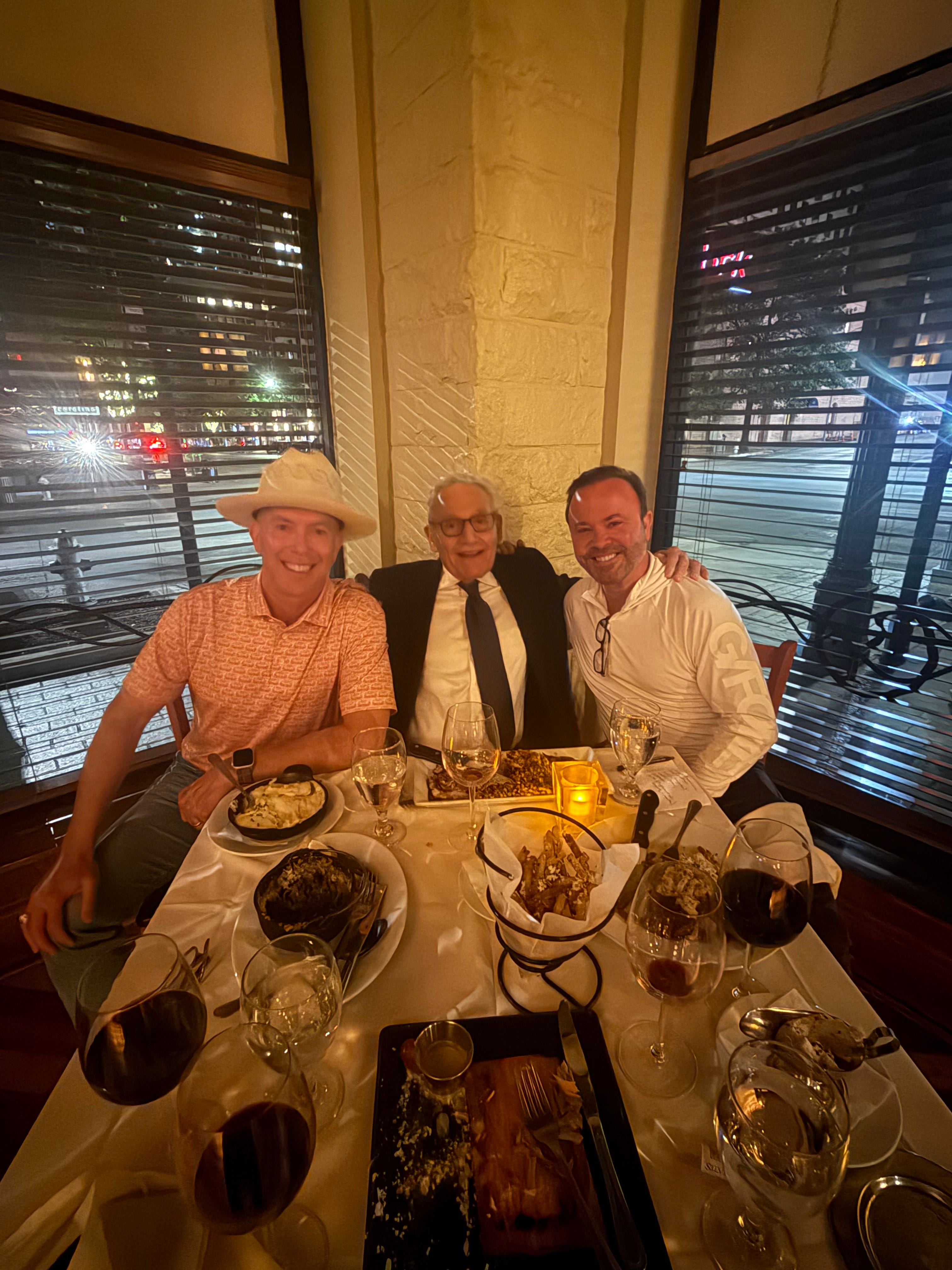
And thanks to my friend Craig Cummings, who knows Bob personally, we were later invited to join him for dinner. Talk about a “first hand” conversation with a legend of journalism. Bob is literally a national treasure and I could not believe I was sharing a meal engaged in a riveting conversation about the state of our nation and our politics.
For nearly two hours, Bob shared stories from his career—how he followed the threads of Watergate when others turned away, how persistence and verification can still bring down the most powerful lies, and how truth, though often slow, always wins the long game.
I told Bob what I’d never had the chance to say before: that reading his books about the start of the Iraq War—while I was in Iraq—shaped my understanding of journalism’s role as the Fourth Estate. His work showed me how deeply democracy depends on those willing to ask hard questions in dangerous times.
On a further personal note, I got to know a former colleague of Bob, Bill Murphy Jr, who was a Washington Post reporter assigned to cover the territory in Iraq that included my unit HQs. It was a full circle moment in life. More about Bill here and his Substack Understandably.
7) What You Can Do This Week
Practice “policy first” conversations. Start with the problem you want solved, not the team you’re on.
Reward independence. Support candidates—of any party—who publicly buck their side on at least one hard issue.
Push for outcomes. Ask for timelines and metrics on immigration adjudications, street safety, school recovery, and permitting.
If this resonates, share it with a friend who’s exhausted by the lurch. The center isn’t a hiding place—it’s a workbench. Let’s get to work.
Let me know what you’re hearing out there.
Take care,
Joseph
Joseph Kopser
Co-Founder of USTomorrow
PS— I wrote last week that American Farmers want trade not aid.

In what felt like a setback to many of them, Trump announced last week the plan to buy Argentinian Beef. Many farmers and their Republican elected officials broke with the President on his decision.
Let’s distinguish “payback” from holding accountable those who break the law or violate their oath of office.
Thanks for writing this, it clarifies a lot. I completly agree the center is the rudder, but how do we convince people to embrace it when the extremes are so loud? Such insightful thoughts.