


It’s good to be back with you.
It’s been a month since I’ve sent a USTomorrow newsletter. I did something I haven’t done in a long time. I unplugged. No email, no news, no scrolling. Amy and I spent two glorious weeks in France— a river cruise through France’s wine country (there is a future Thomas Jefferson newsletter there) and the Loire Valley (and a future Leonardo da Vinci newsletter there) — and for the first time in years, I let myself be fully present somewhere that wasn’t a screen. From there I went to Boston to celebrate the retirement of one of my favorite professors at the Harvard Kennedy School, David King — an evening of speeches and toasts that recharged my batteries in ways I wasn’t expecting. And then home to Lexington for Mother’s Day, to visit my mom in her final resting place.
I came back with a lot to write about. Future newsletters will get into:
Why more Americans need to get a passport and actually travel abroad — there is no substitute for seeing your country from the outside.
Why we’d all be better off watching less news and substituting short-form for longer-form pieces. The attention economy is winning, and we are losing.
Why beating up on our European allies is both wrongheaded and historically illiterate — and why a walk through Paris, from the Revolution to the modern day, will show you more American tributes than most Americans have ever bothered to count in present day Paris.
But that’s for later. I’ll package those up over the coming weeks.
What I want to focus on today is the fact that during those two weeks unplugged, I got to read several books cover to cover (Amy says I have to clarify that I listen to Audible). Of those four, the one most worth your time right now is almost ten years old: Robert Gates’ A Passion for Leadership, published in 2016, on the discipline of leading large organizations — bureaucracies, governments, and businesses alike. We are watching in real time, in both the public and private sectors, what happens when people running large organizations lack the skill or experience Gates spent his career honing. Much of what he foreshadowed and warned against a decade ago is playing out right now. More importantly, the book offers a recipe for going forward.
So let’s start there.
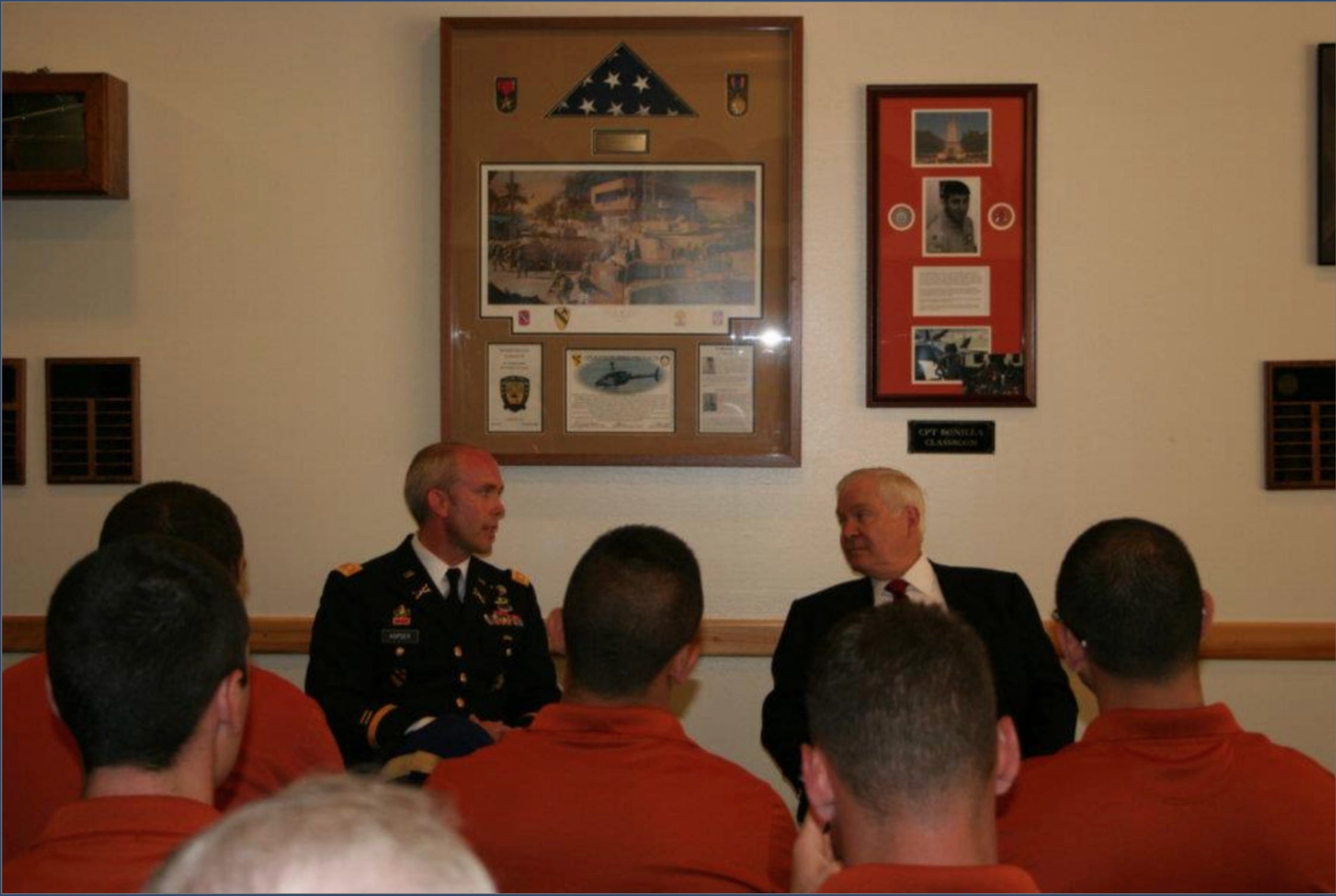
If you know Robert Gates, you know he is a national treasure. His perspective on service isn’t theoretical. It runs through the CIA, the presidency of Texas A&M, and his tenure as Secretary of Defense — decades of institutional leadership across both parties. I’ve been a fan since I first met him shortly after he became SecDef in 2006, when he and his team flew into Mosul, Iraq. What struck me wasn’t the visit — it was how far forward he came to the front. When he writes that he wants to hear from Soldiers and frontline supervisors, he means it. I heard the same thing from friends and mentors who knew him well — Steve Smith, George Casey, Pete Chiarelli — and from leaders like Howard Schultz: Gates is the real deal. I later got to host him at the University of Texas in 2012 for a fireside chat with our ROTC cadets. It was off the chain amazing.
One detail in the book stuck with me harder than I expected: Gates traces his own life of service back to John F. Kennedy’s call to public service. A generation of Americans heard “ask what you can do for your country” and built careers around it. Gates was one of them. I was another, in my own small way. In 1989, while still in high school, I gave a speech to the United Way on the same theme — service to country, service to community, service to something larger than yourself.
I think about that speech often, because I think we’ve lost something in the decades since.
People become what they can see. I tell audiences this constantly. If young people grow up watching leaders campaign against government, mock career public servants, and treat the civil service as a punchline, we shouldn’t be surprised when they choose other paths. Role-modeling isn’t a soft skill. It’s the single most consequential thing a leader does — and the cheapest investment we can make in the next generation of public servants.
Gates also lands hard on something every leader of a large organization needs to internalize: numbers don’t lie, but people do — in the way they manipulate them. Pick the wrong metric, and you incentivize the wrong behavior every time. Body counts. Standardized test scores. Quarterly earnings. Arrests. Wait times. Every one of these has, at some point, distorted the very thing it was meant to measure. The point isn’t that measurement is bad. It’s that lazy or politically convenient measurement is corrosive. Choosing the right goals is the leader’s job — and getting it wrong cascades through every layer of the organization below.
This points to a bigger problem in America we don’t talk about enough: numerical illiteracy. We are a country that struggles to read statistics, weigh one measurement against another, and tell absolute risk from relative risk or correlation from causation. A democracy that can’t read its own data is a democracy that can be sold almost anything. The consequences land hardest on the institutions trying to make evidence-based decisions in front of a public that has been trained to feel rather than calculate.
The media environment doesn’t help. Gates notes — and he’s right — that the press rarely focuses on people doing what’s right. “If it bleeds, it leads” was always true of news. Social media has industrialized it. Every platform is engineered for clicks, outrage, and stickiness. There’s a new book by David Epstein on the importance of constraint and focus, discussed in a recent EconTalk with Russ Roberts, that I’d recommend to anyone trying to think clearly in this environment. Leaders who govern well in the next decade will be the ones who can quiet the noise long enough to choose where their attention goes — and what their institutions optimize for.
The parts of Gates’ book that hit hardest, though, weren’t the program cancellations or the policy victories. It was his respect for career public servants — the civil servants, federal employees, state workers, and local administrators who show up regardless of who won the last election.
There’s a figure in Army culture sometimes called “the little old lady in tennis shoes” — a euphemism for the career public servant who outlasts every commander rotating in and out. She knows where the bodies are buried. She knows why the last three attempts at reform failed. She knows which lever to pull to make something actually stick. She’s invaluable. And she’s perpetually underestimated. The political reflex to campaign against government, to treat these people as obstacles rather than partners, is one of the most damaging habits we’ve developed in modern American politics. It costs us reform we could otherwise be celebrating.
Years ago, a friend and colleague — Margaret K., herself a career public servant whom I met running for Congress — pulled me aside after I made an offhand remark. I had said, half-joking, that if something was “good enough for government service, it was good enough for me.” She looked me in the eye and calmly explained how demeaning that phrase is to the people who forego private-sector pay and public recognition to serve with diligence and integrity. I’ve never used it since. And I’ve never forgotten the lesson.
Here’s what baffles me about the current moment: there is a real need for innovation and reform across many sectors of government. Gates proves it’s possible. In 2009 and 2010, in the Pentagon, I watched him cancel the Army’s Future Combat Systems and other programs that were bloated, out of scope, and over budget. Hard, consequential reform — done by earning credibility with the people inside the system, not by declaring them the problem.
When you walk into an institution with contempt for the people who built it, label them as obstacles, and govern by humiliation, the backlash from both inside and outside is predictable. That’s not resistance to change. That’s how human beings respond to being treated as enemies in their own house. I wrote about the Elon Musk disruption with DOGE when people could not believe what he was doing. I think Elon should have read Gates’ book before he started.
Gates also reminds us that humor matters in leadership — at every level. People are surprised when I say this, but even in combat we made room for levity and sarcasm. Not despite the stress. Because of it. Leaders who can’t laugh — at the situation, at themselves — burn out themselves and their teams.
If there is a single thread running through A Passion for Leadership, it’s this: real change in any large organization, and especially in government, comes down to two disciplines.
Listen more than you talk. And power down responsibility to the people closest to the work.
That’s it. That’s the whole job.
If we want a better government — and the next generation of Americans willing to build it — we should start by modeling those two disciplines ourselves.
Joseph Kopser
Co-Founder of USTomorrow.us
More about me at JosephKopser.com
One of your best letters
If the past two decades of federal leadership have shown us anything, it is that a leader’s image and presentation are far less consequential than the tangible results they deliver and the change they drive in the status quo.