


How do the Democrats go from losing by less than five points statewide in Texas in 2018 to potentially losing five congressional seats statewide in 2026? It was recently hard to imagine, but I think the leadership of the Texas Republican Party is about to make it happen.
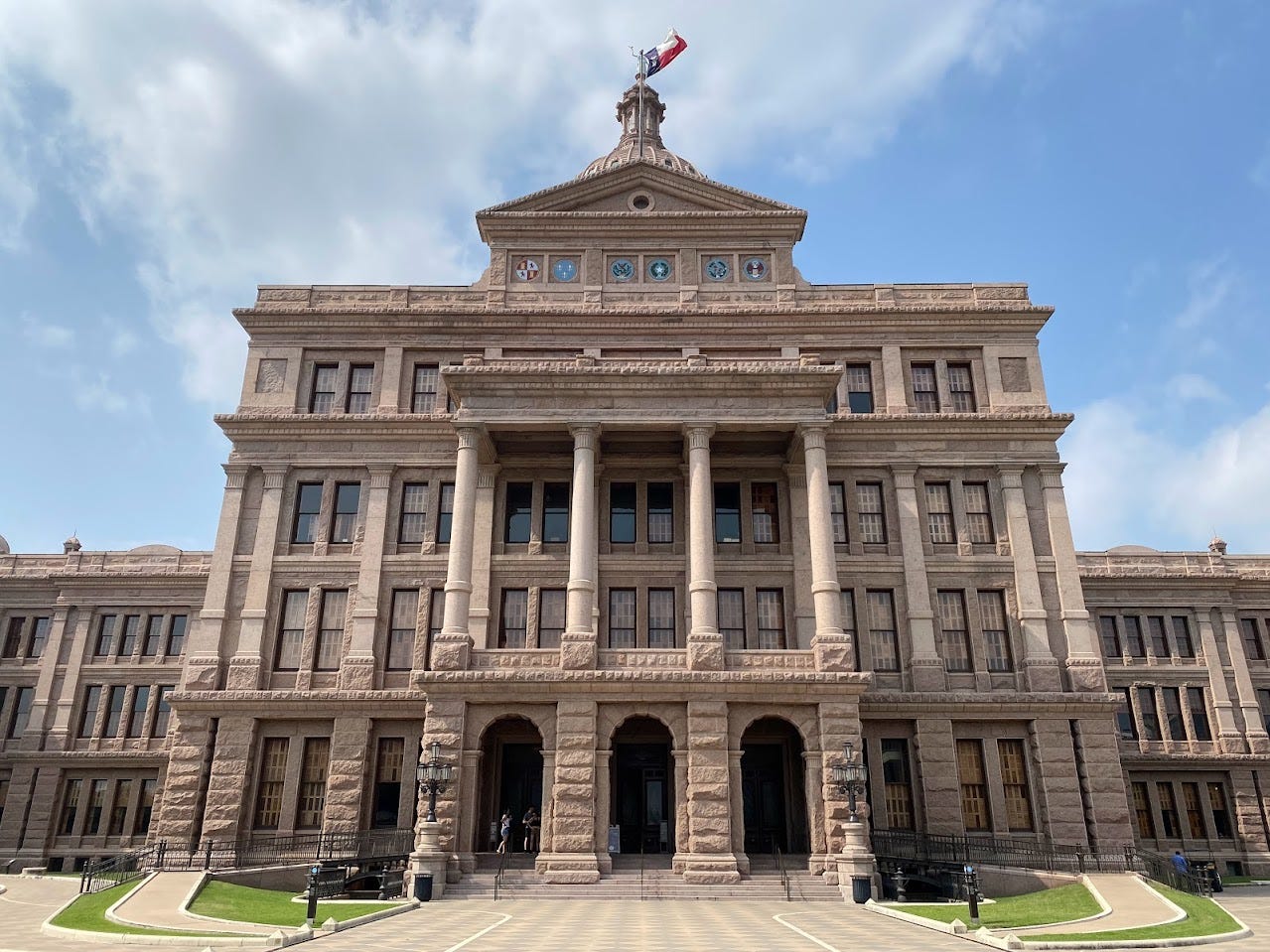
From 2018 Momentum to 2026 Losses
As someone who’s been a Republican, a Democratic candidate, and always an independent-minded moderate, writing this newsletter is both a challenge and a warning — driven by my belief that Texas (and the country) is strongest when two parties compete with serious ideas for the future.
Most reasonable people agree that gerrymandering fuels a downward spiral of political extremism and division. Both parties have used it when in power — it’s a time-honored, if troubling, tradition. But I’m convinced there’s only one way to beat it in the long run. Today, I’ll focus on Texas as a case study, even though this problem plays out in legislatures across the country.
A Warning From the Middle
My advice to Democrats as they create a strategy to mitigate Trump's and Abbott's Texas Plan to create five new Republican congressional seats: Take the time to present an alternative strategy that has a better chance of winning long-term—to compare stated Republican goals and values versus what they're actually delivering with our neighbors, in many cases - and ideally - Republican moderates.
Rather than trying to beat them in the courts, beat them in the court of public opinion.
Rather than yell with a bullhorn on the steps of the Capitol, knock confidently on the front doors of voters not yet met.
Rather than raise money to pay lawyers to fight additional court cases, spend money to hire more communications staff to meet voters where they are.
Thinking for one minute that the Texas Republican legislature will acquiesce to the logic of constitutional precedence is taking the bait. Only moderate voters can make a difference in the near term. Find them, listen to what they have to say and, for the sake of the Republic, find some common ground. After all, Governor Abbott primaried nine of his own fellow republicans that did not vote with him on his School Voucher program.
Strategy Over Protest
I understand the sentiment of those who wish things were the way they used to be—or the way they believe they ought to be in an ideal world—but I’ve found more success by dealing with the reality in front of me and working to shape a better future.
Of the five Texas districts likely to be gerrymandered, Trump won two in the last election. Despite a Democrat holding on to win both seats, Trump carried both districts over Harris.
Some outside analysis might be helpful. Houston Chronicle journalist Jeremy Wallace offers a clear-eyed look at Texas redistricting politics that defies easy partisan spin. In a series of articles, he highlights internal Republican frustrations, notes that even Ronald Reagan once stood against this kind of gerrymandering, and reports on the targeting of Democratic Congressman Al Green’s seat. Yet despite the moral arguments and the historical precedent, Wallace also makes it clear—though not explicitly—that Democrats have little mathematical or legal leverage to stop this in the courts.
It’s a reminder that winning in court is unlikely, but shaping the court of public opinion may be where the real opportunity lies.
Since Beto O’Rourke’s historic 2018 campaign, Texas Democrats have steadily moved away from the moderate middle that once powered their momentum. That disconnect—not democracy or the Constitution—is their real challenge. That middle came out big not only in 2018, allowing Beto to almost be the first statewide Democrat in 40 years (lost by 2.5 points) —but they also shrunk the U.S. Presidential gap between Trump and Biden in 2020 to single digits (Biden lost Texas by 5.5 points).
But since then, I’ve seen no real evidence that Texas Democratic leadership understands that it is the disaffected middle voter that has tremendous sway in close elections. Beto lost to Abbott in 2022 by almost 11 points. Harris lost to Trump in Texas by almost 14 points. With each election cycle, Democrats drift further from the energy and momentum of 2018 — and further from the moderate voter who made that moment possible.
I’m also not sure Democratic party insiders understand or appreciate the size of the voting population who would be on their side. We live in a world of short attention spans. Reality TV, TikTok, and sensational headlines dominate the news cycle. When Democrats do get a sliver of public attention, abstract legal arguments about gerrymandering rarely break through. Voters want to hear about jobs, education, and their kids’ futures.
Instead, they should be speaking to Texans about the realities of jobs, education, and their kids’ futures.
I hear talks of walkouts from the Texas Legislature to prevent a quorum. But I also know that those walkouts two cycles ago resulted in the exact same vote that would have happened anyway.
While I hear claims that the reason they need to do this is to prove they’re “fighting back” to motivate their base, I fundamentally disagree. I think a better use of time, treasure, and talent would be to craft a message that motivates Texas voters—the majority of whom were against school vouchers for instance. But through strategic manipulation of the rules and inside party politics, Republicans got the vote passed anyway. The fate of the school voucher bill came down to a last-minute phone call from Trump to Republicans in the Texas state legislature, where he communicated that if they didn’t support school choice, he would support a primary opponent.
A Chance To Compete For The Center
There is real ground that moderates from both parties can seize to align with more Texans. Just last week, the Builders Movement launched Builders | TX laid out the areas where most Texas agree.
This is a real chance for Texas Democrats to move closer to where the majority of Texans sit ideologically.
This is a real chance for Texas Democrats to craft a message that reflects the values of the voters here — not the talking points of national Democrats in states like New York or California.
This is a real opportunity for Texas Democrats to reconnect with the ideological center — and with the voters they’ve been drifting away from.
If Texas Democrats move closer to the middle, it will pressure Texas Republicans to do the same. That’s not just theory — it’s exactly what happened after Democrats gained 12 seats in the 2018 election. The result was a more cooperative and civil 2019 legislative session, with both parties paying closer attention to the moderate voters in the middle — which is exactly where most Americans live.
Let me know what you’re seeing out there.
Joseph
Joseph Kopser
Co-Founder of USTomorrow
fine - but fight the TX bullshit with aggressive gerrymandering in CA and NY - can't let Repulsicans control the House in 2926
The problem with this analysis is it leaves out the people who can vote, but do not. They are mostly not highly ideological. Kopser thinks there is only one kind of moderate: someone who has an explicit taste for deal-making between elected representatives of both parties. There is another kind: people who don’t feel particularly motivated by the stated aims or record of either party. They do not fetishize deals like Kopser, a businessman and owner, does. The Center for Working Class Politics is focused on the group Kopser ignores. https://images.jacobinmag.com/wp-content/uploads/2025/07/20091032/CWCP-Jacobin-report-20250721.pdf