


If we’re serious about fixing what’s broken in our political system, we have to start by being direct about what’s wrong with it.
Over the last four months on the campaign trail for the Texas House, I got a second look from a front-row seat, seeing how the system actually works—not how we hope it works. What I saw should concern anyone who cares about accountability, participation, and results.
As we head toward the midterms, I’m launching a USTomorrow series to take a clear-eyed look at where our system is falling short—and what we can do about it.
But this isn’t just my perspective.
I want to hear from you (and the other nearly 9,000 UST readers)—what you’re seeing, what’s not working, and what needs to change. Because if we’re going to rebuild trust in the system - and overcome the gigantic effort underway to sow doubt in it - it starts with honest conversations and shared ownership of what comes next.
Do Your Homework Before You Vote
How does a candidate win an election without running a campaign at all?
That’s not a rhetorical question. Voter “preferences” sometimes deliver surprising results.
In the Texas House District 19 Democratic primary (next door to the District I ran in), a candidate who reportedly believed he had stepped aside from the race still ended up winning the nomination. He (Kelly Hall) had spent only about $750 covering filing fees, put up no yard signs, and did little of any traditional campaigning. No website. And yet he won by nearly 20 points. In mid-January, Kelly changed his mind to not run for Texas House and decided to run for mayor of Round Rock.
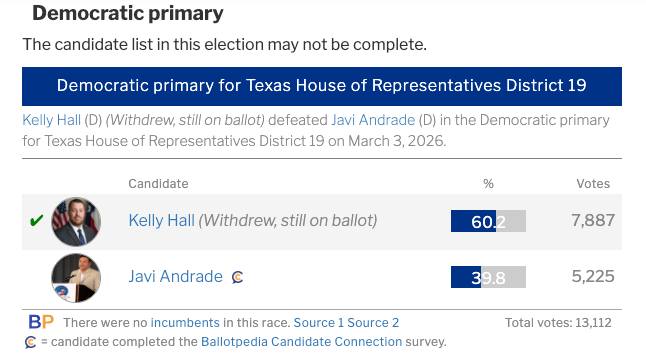
Meanwhile, the opponent he defeated (Javier Andrade) was an Army veteran and cybersecurity professional who had received the endorsement of the Austin American-Statesman.
When the results came in, the outcome surprised nearly everyone—including the winner himself. Friends reportedly interrupted a Call of Duty session to let him know he won the primary.
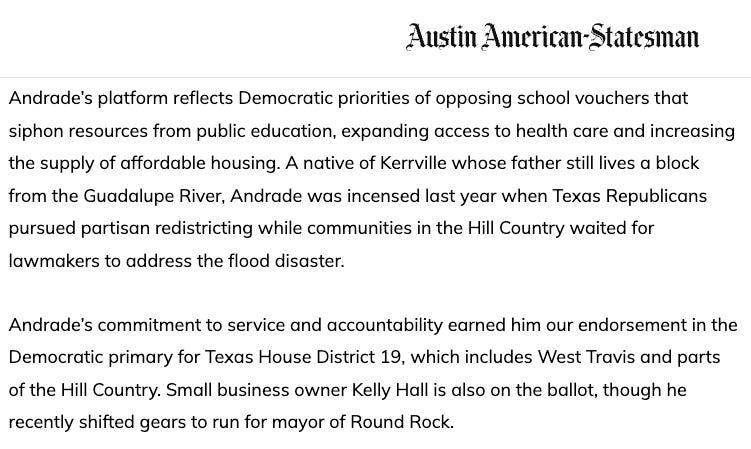
So how does something like that happen? Seriously. I’m asking you, the reader, to reply and let me know how you think it happens. I have my theories that I plan to lay out in the next several USTomorrow newsletters.
For now, let’s take a look at a few underlying factors. Because the answer isn’t just about one contest. It reveals something deeper about how voters behave—especially in primary elections and down-ballot races.
The Information Problem in Down-Ballot Races
Political scientists have studied voting behavior for decades and consistently find the same pattern:
The farther down the ballot you go, the less information voters tend to have.
When voters lack information, two things usually happen:
Ballot roll-off – some voters simply skip the race entirely.
Shortcut voting – others rely on cues instead of research.
Those cues can include:
Name recognition
Incumbency
Ballot order
Perceived gender or ethnicity inferred from names
Researchers call these heuristics—mental shortcuts that help people make decisions quickly.
Sometimes they work well.
Sometimes they don’t.
And in low-information environments, they can produce surprising outcomes.
Primaries Magnify the Problem
Primary elections amplify this effect.
Unlike our currently hyper-partisan, gerrymander entrenched general elections, where party labels provide a strong signal, primaries usually feature candidates from the same party. Voters cannot simply choose the candidate with the (D) or (R) next to their name.
Without that cue, voters must rely on other signals to make decisions.
At the same time, primaries usually have lower turnout and less media coverage.
That means fewer voters—and less shared information.
Which is exactly the environment where unexpected outcomes become possible.
Civic Literacy Matters
This is where civic education becomes critical.
Surveys from the Annenberg Public Policy Center show that about 70% of Americans can name the three branches of government.
That’s encouraging. (And a little discouraging its not 95%)
But it also means millions of voters struggle with even basic civic knowledge—making complex ballots harder to navigate.
Civic education isn’t just about memorizing facts.
It’s about learning how to find credible information, compare candidates, and evaluate sources.
In other words:
It’s about learning how to do your homework as a voter. Don’t vote unless you really know who you are voting for. In this case, 7,887 voters “for” Kelly Hall are likely to have done literally zero homework on the race before casting a ballot.
The Ballot Box Is Powerful
Every election season, one song captures the essence of American democracy.
Willie Nelson sings it simply:
“The biggest gun we’ve got… the ballot box.”
“If you don’t like who’s in there, vote ’em out.”
He’s right.
The ballot box is one of the greatest inventions in human history.
It allows citizens to change leadership without violence.
But powerful tools only work when we use them carefully.
If the ballot box is the “weapon” of democracy, then responsible citizens have two jobs:
Show up.
Aim.
Showing up means voting—especially in primaries, where fewer voters determine who appears on the November ballot.
Aiming means taking a few minutes to understand the candidates before casting your vote. Or skip that race and don’t vote.
A Simple Civic Habit
Doing your homework doesn’t require hours of research.
It might simply mean:
Filling out a sample ballot before voting
Reading one or two trusted voter guides
Looking up the candidates’ backgrounds
Checking credible journalism or endorsements
Those small steps replace guesswork with knowledge.
And when millions of voters do that together, democracy becomes stronger.
Granted, the Texas House District 19 race may be unusual.
But the conditions that produced it—low information, primary turnout, and shortcut voting—exist in elections across the country.
If we want the ballot box to do its job, we have to do ours.
Because democracy works best when citizens vote with reasons.
Before we end, why do you think Kelly won by nearly 20%?
Let me know what you think and what you’re seeing out there.
Joseph
Co-Founder of USTomorrow
I have a detailed response to this AWESOME post which I should be posting in the next 24 hours. I'd already planned a Substack post on the fiasco in Dallas County on Election Day. This amplifies the points that I was going to make in that post.
In the meantime, I would share this post from almost 2 years ago ... https://sharonlawrence.substack.com/p/elections-countdown-to-elections. (Poor voter education is NOT a recent problem nor confined to this area.)
BlueVoterGuide.org does the research for you including nonpartisan races. We help you confidently vote blue all the way down the ballot.