


We’re one week out. And if it feels like the world is spinning a little off its axis right now, you’re not wrong. Our politics are cracked, and not just here at home. Pick almost any democracy on the map and you’ll find the same fault lines.
So I can’t think of a better metaphor than what just happened to the Eisenhower globe.
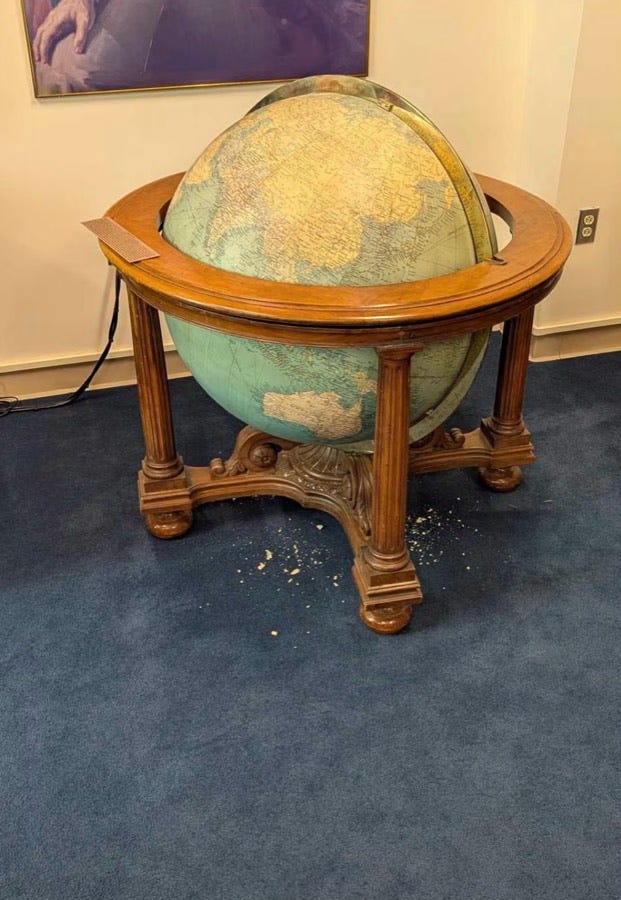
Back in February, Secretary Hegseth’s team decided the globe should be moved into his office. The Army’s historians, the people who actually know how to move a priceless artifact, were furloughed during the shutdown. So rather than wait for the experts, his staff tried to do it themselves. They dropped it (no, I’m not making this up). It now has a gash near Antarctica, and the sphere came loose from the mount that lets it turn. We only found out this month, when The Washington Post got the photos.
That one hurts me personally. When I worked for GEN George Casey, he was the Army Chief of Staff and that globe sat in his office. I used to bring friends in just to see it. You could still see pen marks on it from when Eisenhower was talking through the future of World War II. An amazing piece of American history.
Imagine that. Consulting the experts before you break something yourself.
That being said, we’re one week out, and there are important lessons to learn no matter how it turns out.
The middle is showing up
We’re one week from a consequential midterm, heading into the last two years of this administration. I don’t have a crystal ball. What I do know is that if we’re truly going to move forward as a country, both parties need to recognize that their rhetoric has had its good days and its bad days. And both are arriving at the same intersection.
It’s not only the intersection of the midterms and the second Trump administration. It’s an intersection of a lot of different groups. The Tea Party. The Bernie Bros. The MAGA faithful. The Democratic Socialists of America. Whatever labels you want to put on them.
But the group that hasn’t received nearly enough attention, and the one that will carry the day next week, is the people in the center. The hardworking men and women of this country who, at every age and every stage of life, are often disaffected or flat out disgusted by politics. Plenty of them stopped showing up because they didn’t think their vote could make a difference.
This year, in a lot of places, they’ve hit a level of frustration that’s bringing them back to the polls. Here in Texas we’re seeing record turnout in the early vote (Dallas, Harris and Travis counties all set first-day records). Amy and I stood in a line that was over 30 minutes. Worth every one of them.
The winners need to remember why they won
But it’ll all be for nothing if, coming out of next Tuesday, the winners forget why they won and the losers don’t appreciate why they lost.
Take one example. The Senate race here in Texas between James Talarico and Ken Paxton.
If Talarico wins, it’ll be in large part because he didn’t just appeal to the Democratic base. He made routine, overt gestures to the middle, even talking about looking forward to working with Republican Senator Ted Cruz. He’s deeply centered in his faith. And he ran on jobs, education and our kids’ future.
If Paxton loses, I believe it’s time for Republicans to realize that thirty years of a monopoly on Texas politics has led to a level of corruption, waste, fraud and abuse that Texans themselves, regardless of party, aren’t interested in. That’s exactly what happened the last time one party held a monopoly here. Democrats ran Texas for decades with no real opposition, and they too drifted off the center and toward corruption and insider dealing.
What worries me most? If Paxton does win, I’m worried Republicans won’t use the near death experience to learn that most people actually live in the center, and they need to speak to their needs. We’ve seen this movie. In 2018 Beto came within three points of Ted Cruz, and Republicans lost a dozen seats in the Texas House. The 2019 Legislature that followed was called one of the most productive and civil in recent memory. I believe that’s because Republicans learned from their near death experience and moved closer to where Texans actually are.
The losers need to appreciate why they lost
I’m equally worried that if Democrats win, they’ll mistakenly read it as a call for the far left to rise up. That the Democratic Socialists will think it was their energy and enthusiasm that did it. And riding those coattails, they’ll push for a resurgence of what the right calls woke politics or identity politics. I worry Democrats won’t remember why they lost so much power after the eight years of the Obama administration (nearly 1,000 state legislative seats, for those keeping score).
Why I’m optimistic anyway
A lot of my friends are bracing for the worst right now. Some of them have already written the post-mortem. I get it.
But I’m optimistic. Optimistic that we’re moving back toward the center of our politics. Optimistic that people who for too many years turned a blind eye to the dereliction of duty, the brazen corruption and the disregard for the everyday voter are done looking away. Those days might be numbered.
If this country ends up closer to 50/50, that’s cause for celebration. Rather than red and blue, maybe we realize we’re something far more purple. And maybe both sides sit down and think about why that is.
2026 might be a wonderful turning point in our nation’s history. One where we leave politics at the water’s edge. Where we stand united in support of our allies. Where we look out for all, even those without a voice.
At the end of the day we have far more in common than what separates us. We’re all focused on looking out for our kids. A great education that leads to a great job. A job that’s meaningful and pays the bills. And a brighter tomorrow for all.
So vote. Bring someone with you. Country over party.
Hit reply. I read every one.
Take care,
Joseph
Joseph Kopser
Co-Founder, USTomorrow.us
P.S. Early voting in Texas runs through this Friday, October 30. Election Day is Tuesday, November 3.
Joseph Kopser is a lifelong problem solver committed to building the teams needed to take on our toughest challenges. He is currently President of Grayline after he co-founded and served as CEO of RideScout, before it was acquired by Mercedes. He served in the U.S. Army for 20 years earning the Combat Action Badge, Army Ranger Tab and Bronze Star. He is a graduate of West Point with a BS in Aerospace Engineering and also received a Masters from the Harvard Kennedy School and former member of the Army Science Board. He was recognized as a White House Champion of Change for his efforts in Energy and Transportation as well as won the U.S. DOT Data Innovation Award. He co-authored the book, Catalyst, a book focused on helping teams adapt to change. He is the Chair of the Board of Advisors for the CleanTX, an economic development and professional association for energy innovation. In 2025, Joseph was selected for the Texas Business Hall of Fame Future Texas Business Legend Award. Joseph and his wife of 31 years, Amy, live in Austin and they are extremely proud of their three adult daughters living their best lives.
Joseph - The globe story got me. Dropping a piece of Eisenhower's thinking because nobody wanted to wait for the people who knew how to carry it is about the most on-the-nose metaphor this year could have handed you.
Your line about the winners forgetting why they won is the one I keep coming back to. We both spent careers watching units win a fight and then lose the peace because they read the wrong lesson from the victory. Same risk here, whichever way next Tuesday breaks.
Good on you for writing to the middle instead of the margins. Country over party. See you out there.
I pulled the numbers for Early Voting turnout in Texas through COB yesterday. Head on over to my Substack (Information Bank) for a deep dive into the jurisdictions to watch. It's interesting to see where the turnout leaders are ...