


This one’s for paid subscribers, and it’s a little different. Tonight is the night before the election, and I’m going to put my predictions in writing. Two of them. What I think happens tomorrow in Texas. And what I think happens to Texas (and to Austin) if tomorrow goes the way I think it might.
I could be wrong. That’s the deal with predictions. But I’d rather be on the record than on the fence.
Here’s the short version: I think we’re looking at a perfect storm. Partly literal.
A perfect storm, literally.
Start with the variable no campaign can control: the weather.
Forecasts show a strong front moving across Texas, with the highest probability of storms in the ten-day window falling on Election Day itself. Cooler temperatures, rain, and a sharp swing. That sets up a straightforward stacking of conditions that several observers have noted.
Early-voting messaging this cycle has repeatedly questioned the reliability of mail and early ballots. The practical effect, according to those tracking the numbers, is that a meaningful share of older, more traditional Republican voters appear to have held back for Election Day in-person voting. At the same time, a number of counties have reduced the number of polling locations. Analysts differ on the intent, but the operational result is the same: fewer sites, longer potential lines, and weather that can further slow movement.
Put those three factors together—reduced polling capacity, lines, and weather—and the turnout that materializes on the day is likely to be disproportionately composed of the most motivated voters. The open question the data raise is which side’s remaining voters are more willing to stand in those conditions.
Derek Ryan, the Republican pollster whose early-vote reports are widely treated as one the clearest running scorecard in Texas, has the early numbers running close to the 2018 pace (the Beto–Cruz year). He has indicated that total turnout could approach 10 million. That figure already reflects a large cohort that chose not to wait. Democratic operative Matt Angle has similar views.
Regardless of who wins, I hope the winners learn from what the voters really wanted and I hope the losers really think through why they lost. Worse case, the winners and lose blame the wrong circumstances for their loss. I wrote more about this last week in this piece about how we are one week out.

Four dynamics pulling different voters
What several Texas observers have highlighted as different this cycle is the simultaneous presence of four distinct draws:
James Talarico has been positioned as a moderate white candidate able to reach some of the Republicans who voted for Biden in 2020—voters who, by multiple accounts, respond poorly to high-volume messaging.
Gina Hinojosa, the Austin-area state representative, has emphasized her Valley roots and Hispanic heritage. Analysts following Latino shifts have noted the possibility she pulls back a portion of the voters who moved toward Trump in 2024.
Bobby Pulido, the Tejano star, is on the ballot in the 15th Congressional District against Monica De La Cruz. In a seat Trump carried by 18 points, the race is now competitive in part because Pulido is bringing out voters who have not participated before.
Jasmine Crockett has been actively working to turn out Black voters in DFW and Houston for down-ballot races. Texas political observers have remarked that it is unusual to see all four of these efforts operating at the same time.
If not this time, next time
Jeremy Wallace at the Texas Take noted on his podcast a September post by Bo French (the Republican nominee for Railroad Commissioner). French shared a photo of UT students celebrating a win over Ohio State and objected that the crowd did not look like the Texas he preferred—too many dark-skinned students, not enough white ones. John Cornyn publicly pushed back.
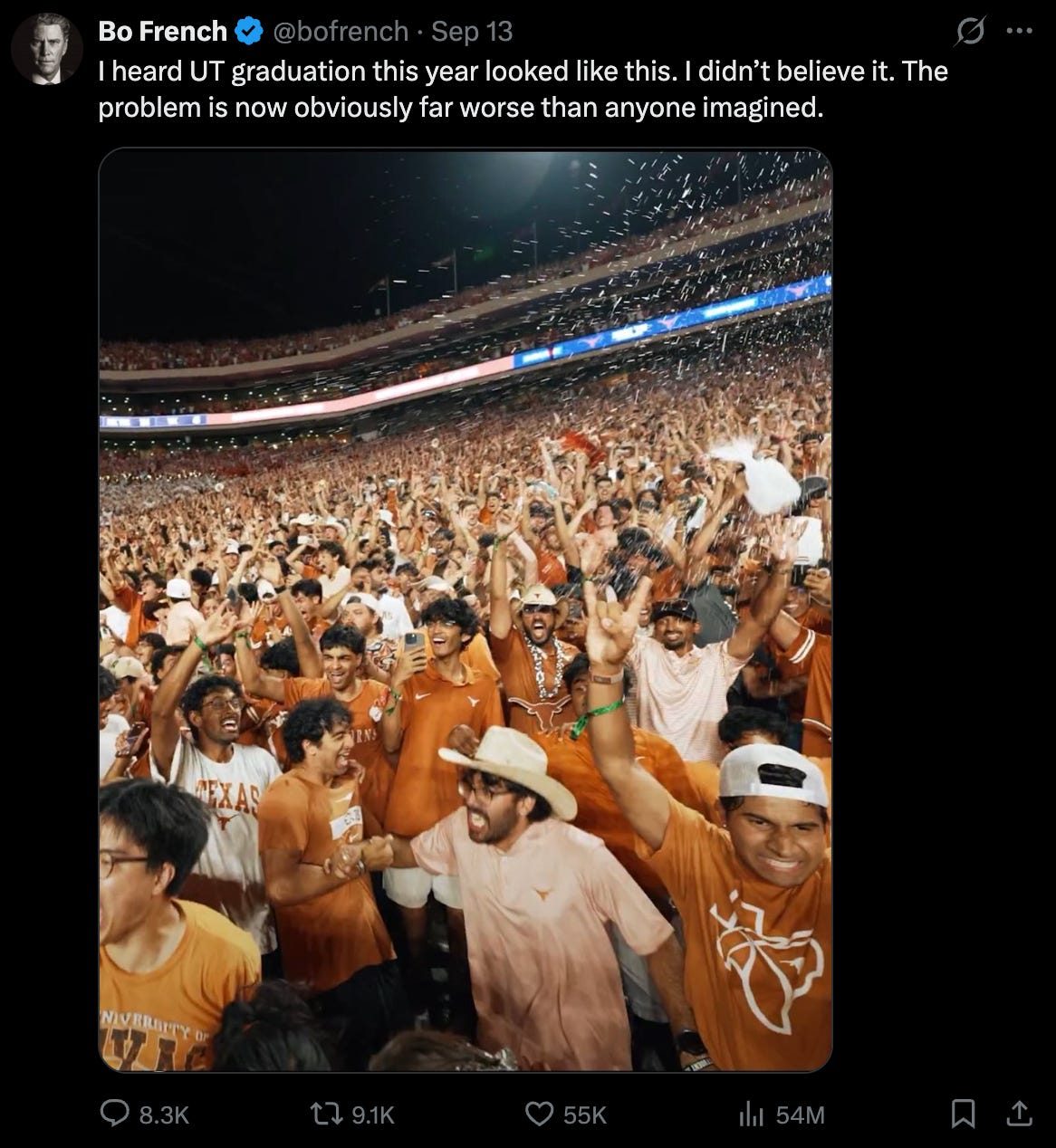
The demographic baseline is straightforward. Of the Texas public high-school graduates in the class of 2024, roughly 26 percent were white. Texas has rewritten its identity multiple times; the Six Flags sequence (Spain, France, Mexico, the Republic, the Confederacy, the United States) is the historical record of that. Population and political composition continue to change. That is descriptive, not speculative.
Scenario: what a sweep would actually change
A number of analysts have sketched what a Democratic sweep would mean in practice, particularly in Austin. The following is a synthesis of those points rather than a forecast.
Governor Gina Hinojosa would make roughly 1,500 appointments over a four-year term—boards, commissions, regents, task forces. For a generation those seats have come from one political network. A new governor would fill them from a wider range of the state (the Valley, West Texas, people who have not previously been asked). That alone would reshape administrative continuity for the next decade regardless of the eventual margin.
Lieutenant Governor Vikki Goodwin would preside over a Senate that still holds a Republican majority. The Senate writes its own rules at the start of each session, including the powers of the presiding officer. The resulting arrangement would be either gridlock or the first sustained bipartisan Senate in recent memory—most likely elements of both, especially in the opening weeks of January.
The seat analysts are already watching: Senate District 14
If Sarah Eckhardt wins the Comptroller race, she would resign her Senate District 14 seat (to which she was re-elected in 2024). The vacancy would fall mid-term and out of cycle, triggering a special election.
The 2020 precedent is clear. When Kirk Watson left the same seat, the special election had no primary; everyone ran on one ballot. It more closely resembled an Austin mayor’s race than a standard partisan contest with polarizing primaries, with the difference that party labels still appear next to names. Democrats, Republicans, and independents share the ballot; every voter in the district chooses from the full field.
In 2020, Sarah (then Travis County Judge) and Eddie Rodriguez (the longtime state representative covering a large share of Austin) both ran as Democrats with high name ID. Neither reached 50 percent. Eddie conceded rather than proceed to a runoff, and Sarah became the State Senator.
Timing adds a further variable. The governor calls the special. A Comptroller is sworn in on January 1; a new governor is sworn in later in January. The date of resignation therefore determines which governor sets the election calendar.
Why the center is the relevant variable
Austin’s last three mayors supply the clearest recent pattern: Lee Leffingwell (right of most of the council), Steve Adler (centered relative to more progressive council members running), and Kirk Watson (2022). Each received measurable support from centrists and moderate Republicans who voted for a Democrat because they preferred a more balanced mayor. Will that apply to the State Senate special election to represent Austin?
In a one-ballot special for SD-14, independents and Republicans can vote for the candidate closest to their preferences. In a district this blue, that historically favors the Democrat who presents as a problem-solver rather than a national party politics.
Names that have been mentioned in local discussions include:
- Eddie Rodriguez (a second run could carry the goodwill from 2020),
- Andy Brown (the successor to Sarah Eckhardt as the Travis County Judge),
- Donna Howard (a very popular current State House Representative),
- Steve Adler (the most recent mayor of Austin),
- Celia Israel (former state representative who ran a competitive mayor’s race in 2022),
- An Austin-area House member looking to move up on a calendar that aligns with the vacancy,
- A centrist or business-oriented independent, or even a moderate Republican, who sees the single-ballot format as the clearest opening available in Travis County.
Those are the names currently circulating among people who follow Austin politics closely. Who else is missing, who runs, and who outperforms expectations are open questions.
The numbers and the expert reads are what they are. Weather, early-vote patterns, polling-place capacity, and the four simultaneous turnout efforts are the variables in front of us. The rest is what the data and the people tracking it are showing.
My prediction…. if lines are over an hour in most polling states at 5 pm in Texas, it will be a Talarico will win and the majority of state wide races will flip from Red to Blue. I think LtGov Patrick will lose before Gov Abbot does.
Take care,
Joseph
Joseph Kopser
Co-Founder, USTomorrow.us
P.S. However you vote tomorrow, vote. Bring an umbrella. And if you see someone who has been in line a long time, bring them a coffee. Country over party.
Joseph Kopser is a lifelong problem solver committed to building the teams needed to take on our toughest challenges. He is currently President of Grayline after he co-founded and served as CEO of RideScout, before it was acquired by Mercedes. He served in the U.S. Army for 20 years earning the Combat Action Badge, Army Ranger Tab and Bronze Star. He is a graduate of West Point with a BS in Aerospace Engineering and also received a Masters from the Harvard Kennedy School and former member of the Army Science Board. He was recognized as a White House Champion of Change for his efforts in Energy and Transportation as well as won the U.S. DOT Data Innovation Award. He co-authored the book, Catalyst, a book focused on helping teams adapt to change. He is the Chair of the Board of Advisors for the CleanTX, an economic development and professional association for energy innovation. In 2025, Joseph was selected for the Texas Business Hall of Fame Future Texas Business Legend Award. Joseph and his wife of 31 years, Amy, live in Austin and they are extremely proud of their three adult daughters living their best lives.