


A Moment of Joy
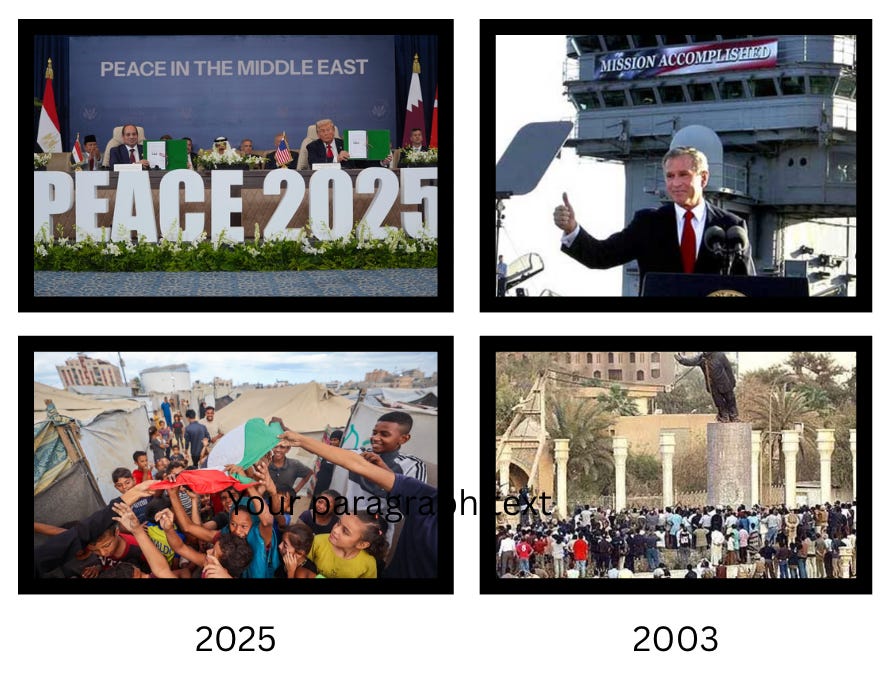
On Monday this week, the world watched a rare moment of relief in the Middle East — the release of Palestinian prisoners in exchange for 20 living Israeli hostages, and the repatriation of others whose fate was far more tragic. For many families on both sides of the border, this moment in time is cause for celebration.
And yet, anyone who’s spent time in the region — or studied its history — knows how quickly peace can unravel. As I watched the celebrations in Israel and Gaza, I could not help but feel like I’ve seen this movie before.
Echoes from Iraq
I remember watching the news from Iraq in 2003 as the crowds pulled down Saddam Hussein’s statue, waving American flags and shouting “USA! USA!” The optimism was electric. Many believed the future had arrived — that freedom had won.
But barely twelve months later, that same landscape was littered with improvised explosive devices. The cheers had turned to suspicion, and then to violence. What began as a moment of liberation morphed into a more than a decade of conflict that claimed thousands of lives and reshaped a generation. In 2004, while I was in Iraq, I wrote about my firsthand account of what I was seeing on the ground in Baghdad as groups within Iraq began to position and posture for control of power going forward.
This cycle of hope and heartbreak isn’t just a Middle Eastern story—it’s a reminder of America’s enduring stake. As we approach the 2026 midterms, how might this fragile truce influence U.S. aid commitments or voter sentiment on foreign entanglements? I am of the belief that the US must remain engaged around the world as a global force for good and a beacon of light to the rest of the world.
The Balancing Act Ahead
So today, as I share in the joy of Israeli families being reunited with their loved ones after years in captivity, I can’t help but temper celebration with caution. Because nothing in the Middle East — or in life — is ever as simple as we hope.
Religion, history, and identity run deep there, binding people together and tearing them apart in equal measure. As I once wrote in a piece in 2004 from Iraq: you don’t need to be a student of international politics to understand the Middle East — you just need to watch an episode or two of The Sopranos. In the end, it’s always about power — who holds it, who wants it, and what they’ll do to keep it. (If you enjoyed Part I above of my published letters from Iraq, you can read Part II here.)
So yes, let’s celebrate today’s fragile peace. But let’s also prepare for tomorrow — because in the Middle East, and in much of the world, peace is not a destination. It’s a balancing act.
In the U.S., tomorrow means reckoning with our role as global broker. Will we double down on diplomacy, or retreat into isolationism? Share your thoughts below—what’s one lesson from Iraq and/or Afghanistan we can’t afford to forget?
Take care,
Joseph
Joseph Kopser
Co-Founder of USTomorrow
I encourage you to click here for more on Linkedin , X-Twitter, Instagram, Bluesky, Medium, and Facebook.