


America turned 250 this month, and I spent part of the weekend doing something I love: bragging about my friends on television who are out there defending it.
CBS Austin with ran a special edition of “Tech This Out” called Defending 250, about the companies building the tools we’ll need to protect the next 250 years
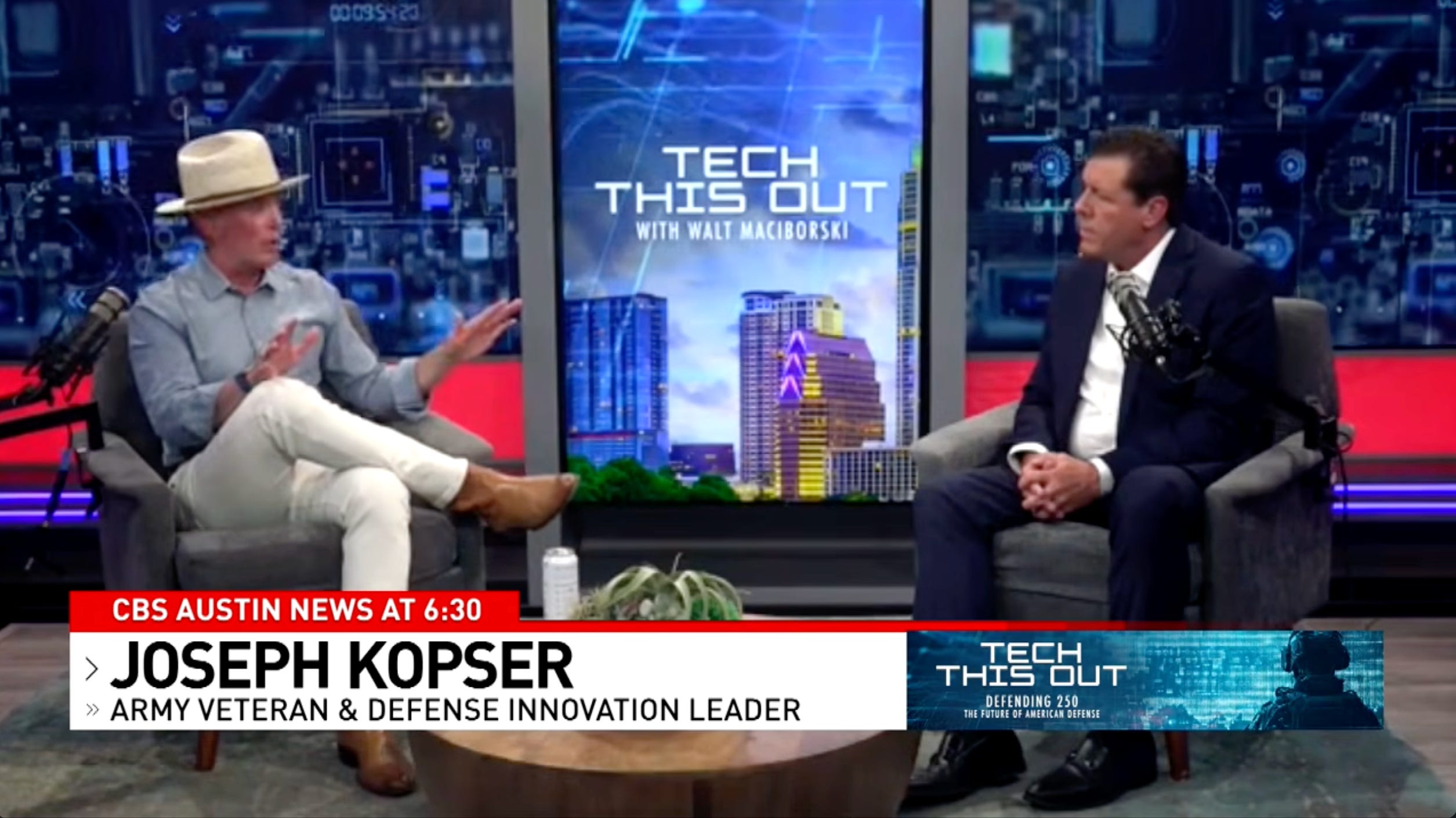
You can see our full discussion here.
They asked me on to talk about the hard part, the part nobody wants to slow down for: how do we move fast on artificial intelligence and still do it responsibly? I’ll come back to my answer. First, look at who else was in the room. Because every one of these companies is within an hour’s drive of my house.
The battlefield changed while we were still arguing about it.
Drones did it. Cheap, fast, and everywhere. In Ukraine, by some counts, roughly 80 percent of casualties now come from drones. That is not a future threat. That is the war being fought right now.
An Austin company called Allen Control Systems is answering it with a machine they named Bullfrog: a standard rifle bolted to an AI brain that spots a drone, measures it, predicts where it’s going, and takes it out of the sky, while the human operator stays focused on the mission. Their co-founder Steven Simoni will tell you we’re still underestimating this threat as a country. He’s right.
Cheap now beats expensive later.
Here’s the math that keeps defense planners up at night. Put a three billion dollar destroyer against two hundred naval drones that cost under a million dollars apiece, and the economics stop working in your favor.
Saronic, right here in Austin, is building the cheap side of that equation on purpose: autonomous boats built to scale. One of them, earlier this year, helped rescue two US Army pilots after their helicopter went down over the Strait of Hormuz. Their team put it simply. Two Americans got to see their families again. That’s the point.
Same story on land. Aeon Industrial is building a shoulder-launched guided missile called Zeus, with 3D-printed parts, aimed at a cost the taxpayer can actually afford. And in the small town of Luling, X-bow Systems has shrunk a rocket-motor factory that used to sprawl across thousands of acres and cost hundreds of millions of dollars down into something the size of a shipping container. A rocket factory in a box, mobile and front-line ready.
You can’t defend what you can’t build.
This is the thread I’ve been pulling on in this newsletter for a while now, from energy to housing: innovation is worthless if you’ve forgotten how to build the thing.
We used to know that. On the outskirts of Lockhart, a startup called Oklo is racing to bring a reactor named Groves One critical, part of a federal push to get new nuclear online. Their CEO put it in a way that stuck with me: America didn’t fall behind on nuclear because of safety. It fell behind on will. We still have the edge in designs and innovation. That edge means nothing if we don’t build them.
And when the Pentagon said crumbling barracks were hurting military readiness, an Austin company answered with robots. ICON 3D-printed ten military barracks in six months. The Department of War told the Senate that job would normally take two years. Six months. Next stop, Fort Polk, and a goal of nearly 900 structures nationwide.
Building at scale is never just one factory. It’s the thousands of suppliers behind it, and right now that base is scattered and brittle. Sustainment, another Austin company, is working to organize our national supply chain into a single connected network, so a program manager can find the American shop that makes the part instead of learning too late that only one supplier left in the country still makes it. You can’t surge what you can’t source.
Fast is not the same as reckless.
So back to the hard question CBS asked me. Here’s my whole answer, and it fits on an index card.
First, don’t panic. Second, stay transparent about what’s under the hood of what we’re building. Do those two things well, and over the long run we’ll be fine.
And there’s a floor underneath all of it that never moves. You cannot do anything illegal. You cannot do anything immoral. You cannot do anything unethical. And if you are ever faced with one of those three things, it is your responsibility to be the whistleblower. Not your option. Your responsibility.
That’s not a brake on innovation. It’s the thing that lets innovation be trusted with the keys. The founders I just named are moving at startup speed on some of the most consequential technology of our lifetimes. The reason I’m comfortable bragging about them is that the good ones know exactly where that floor is.
Which brings me to the news this week.
None of what I just described is a hypothetical. Look at the map.
The Strait of Hormuz, the same stretch of water where that Saronic boat pulled two American pilots to safety, slid back into a shooting war this month. Iran and the United States are trading strikes over who controls it, and roughly a fifth of the world’s oil moves through that one chokepoint. You’re already paying for it. Crude is back near eighty dollars a barrel and the number on the gas pump climbed while you weren’t looking. (I just paid over $100 at the pump to fill up my car.) I’ve written it here before and I’ll keep writing it: energy security is national security. We don’t get to treat the two as separate problems.
And in the middle of all that, the loudest debate in Washington about military readiness landed on testosterone. The Secretary of Defense ordered annual screening for troops over thirty, with hormone therapy on offer. I spent 20 years in uniform, so let me say the uncontroversial part first: I will always take better health care for the people who serve. Check their blood, treat what needs treating, good.
But I’ve stood next to enough Soldiers to know where strength actually comes from, and it has never been a number on a lab panel. It’s the young operator who keeps her focus while the machine tracks the drone. It’s the founder who could have built anything and chose to build for the people who serve. It’s knowing exactly where the ethical floor is and refusing to step below it. That’s readiness. You can’t prescribe it.
And in a serious time of war, I don’t want a single reader of this newsletter mistaking that debate for the main event. A conversation about testosterone at the Pentagon is not the prize. The prize is strategy and diplomacy, and right now we can’t afford to take our eyes off it.
We used to know how to write a strategy.
There’s an old framework we learn early in uniform for the levers a government pulls in a crisis and tries to prevent them. It fits in one word: DIME. Diplomacy. Intelligence. Military. Economic power. Pull one of those without the other three and you don’t have a strategy, you have a reaction. The best example this country ever produced came out of the early Cold War, a 1950 document called NSC-68 that lined all four up behind a single goal: contain the Soviets. Diplomacy, alliances, economic strength, and military force, all rowing in the same direction. In the decades since, politics has crept further and further into our national security strategy, and the coherence NSC-68 had is harder and harder to find.
The good news buried in the Iran story is that the innovation is real. Just as it was remarkable that a Saronic boat could pull two pilots out of the sea, ICON is printing barracks for our troops at a fraction of the old cost and on a timeline nobody thought possible. Those are the two things that have to travel together now: protect the warfighter, and cut the bill. The military is still the single largest slice of discretionary spending in the federal budget, and I’ll be honest with you. Across 20 years in uniform I watched us spend more than we needed to, delay decisions in ways that cost us dearly, and fall short of being the best stewards of your tax dollar.
In a fight, you spend whatever it takes to protect your Soldiers and bring them home. I will never argue otherwise. But firing a multimillion-dollar missile at a twenty-thousand-dollar drone boat in the Strait of Hormuz is not something you can keep doing.
My friend Patrick J. Murphy, the first Iraq War veteran elected to Congress and a former Under Secretary of the Army, made the point sharper than I could in his latest SitRep. Ukraine, he notes, has spent 18 months knocking out Russian refineries worth hundreds of millions of dollars with drones that cost a few thousand apiece, the military equivalent of crippling an aircraft carrier with something assembled from the electronics aisle. His conclusion is the one Washington keeps dodging: “Offense has become cheap while defense remains ruinously expensive.” The next war, Patrick writes, may be decided “not by which country can build the most exquisite weapon, but by which can survive the ugliest arithmetic.” A multimillion-dollar interceptor against a twenty-thousand-dollar boat is exactly that arithmetic, and the math does not get better with time. More from Patrick here: Ukraine’s Cheap Drones Exposed Russia’s Defenses. America Should Take Notice.
That’s the whole case for companies like Aeon. Reinventing how we build these tools lets us defend the homeland, stand up for democracy and freedom abroad, and hand the government instruments it can actually afford to use.
My one real concern in all of this is simple. We have the boats. We’re building the barracks. We can build the missiles that cost what they should. What we don’t seem to have right now is a strategy.
The people are the point.
The host closed the show with a line I wish I’d written. America’s greatest strength has never been the technology alone. It’s the people willing to imagine it, build it, and use it responsibly.
I know it seems like I am talking a lot about machines. But every one of them is really a story about a person who served, or who’s building for the people who do, and who decided Central Texas was the place to do it. That’s the arsenal of the next 250. It’s not in a catalog. It’s in a shipping container outside Luling, on a test stand in Briggs, in a reactor room in Lockhart, and it’s being built by people you can actually go meet.
I’d love to hear what you’re seeing out there. Who’s building something for the next 250 in your corner of the country?
Take care,
Joseph
Joseph Kopser
Co-Founder, USTomorrow.us
P.S. The full CBS Austin segment is worth seventeen minutes of your time: Defending 250.
Joseph Kopser is a lifelong problem solver committed to building the teams needed to take on our toughest challenges. He is currently President of Grayline after he co-founded and served as CEO of RideScout, before it was acquired by Mercedes. He served in the U.S. Army for 20 years earning the Combat Action Badge, Army Ranger Tab and Bronze Star. He is a graduate of West Point with a BS in Aerospace Engineering and also received a Masters from the Harvard Kennedy School and former member of the Army Science Board. He was recognized as a White House Champion of Change for his efforts in Energy and Transportation as well as won the U.S. DOT Data Innovation Award. He co-authored the book, Catalyst, a book focused on helping teams adapt to change. He is the Chair of the Board of Advisors for the CleanTX, an economic development and professional association for energy innovation. In 2025, Joseph was selected for the Texas Business Hall of Fame Future Texas Business Legend Award. Joseph and his wife of 31 years, Amy, live in Austin and they are extremely proud of their three adult daughters living their best lives.