


While the mission set and orders to send National Guard troops into Washington, D.C. are still unfolding, it’s a reminder of how important steady, principled leadership is in moments of uncertainty. As a career Army officer and West Point graduate, the recent story of Jen Easterly—and the sudden reversal of her appointment to return to teach at West Point—struck a deeply personal chord. I followed Jen in the same Social Sciences Department, so I know firsthand the kind of integrity and commitment she brings to service. In today’s fractured world, we need leaders who can build bridges, model moral courage, and choose the harder right over the easier wrong. Jen’s recent words, written after all she has endured, are a powerful example of the grace and resolve we should be celebrating and supporting. I’m sharing her unedited LinkedIn reflection here so all can read it, not just those on LinkedIn.
—
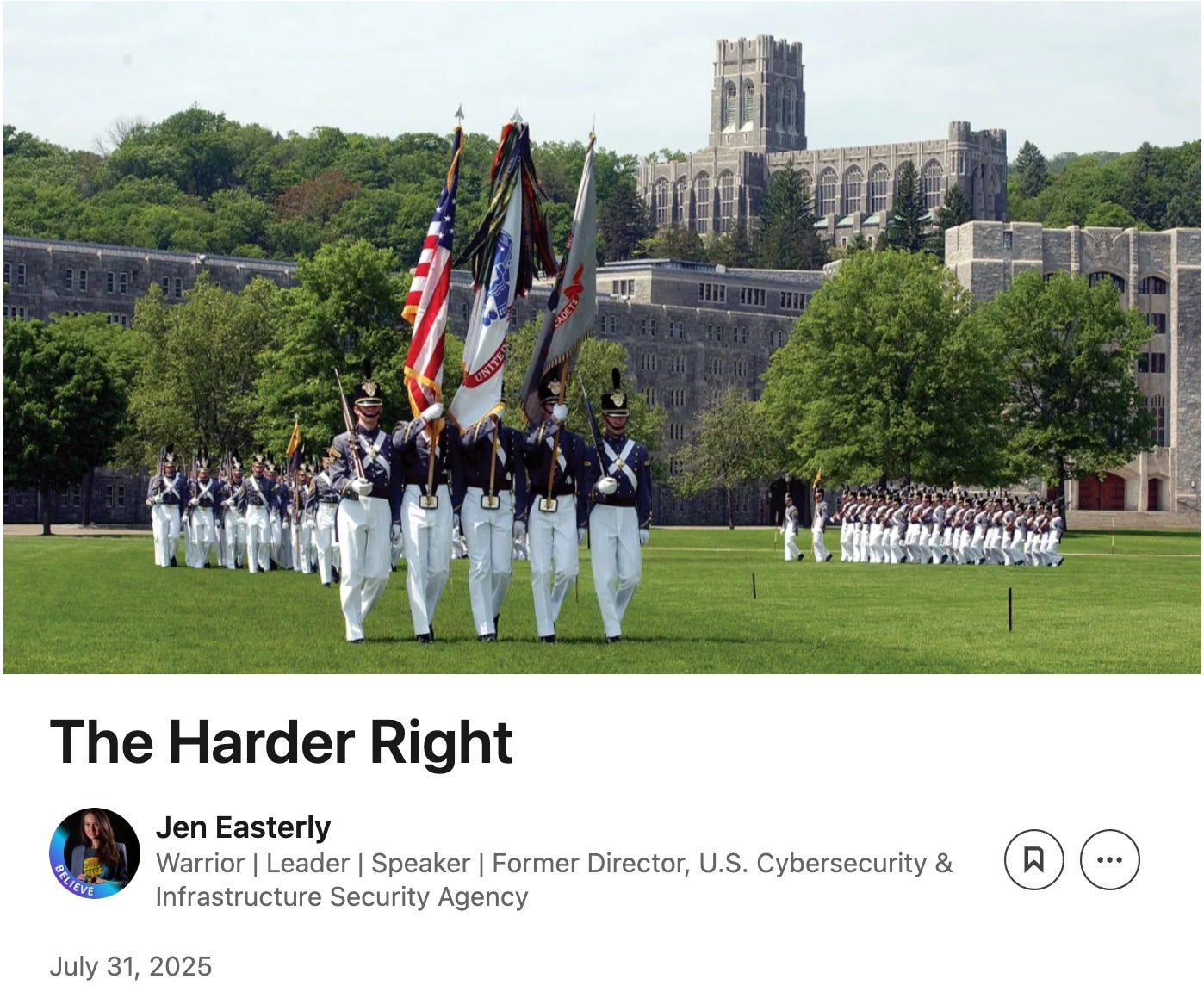
The Harder Right
Jen Easterly
Warrior | Leader | Speaker | Former Director, U.S. Cybersecurity & Infrastructure Security Agency
(This essay originally appeared on Linkedin)
July 31, 2025
I spent 25 years in uniform, including four as a cadet at the United States Military Academy at West Point and two and a half more teaching economics and national security at West Point’s Department of Social Sciences, USMA (a.k.a. “SOSH”). My time as a student saw the fall of the Berlin Wall; my time as an instructor saw the fall of the Twin Towers. Both were seismic events that reshaped our world and the meaning of service for an entire generation.
So when I was invited to return to SOSH as the Distinguished Chair of the Department, I felt a deep sense of responsibility. To give back. To guide the next generation. To inspire and help prepare young leaders for the promise of an era defined by technological innovation and disruption: autonomy, space, cyber, quantum, and most importantly—powerful AI. Indeed, the largely excellent White House AI Action Plan released last week reinforced just how essential it is for our military leaders to understand and effectively leverage these technologies to fight and win our nation’s wars.
Unfortunately, the opportunity to serve again at my alma mater was rescinded—a casualty of casually manufactured outrage that drowned out the quiet labor of truth and the steady pulse of integrity.
As a lifelong independent, I’ve served our nation in peacetime and combat under Republican and Democratic administrations. I’ve led missions at home and abroad to protect all Americans from vicious terrorists, rogue nations, and cybercriminals. I’ve worked my entire career not as a partisan, but as a patriot—not in pursuit of power, but in service to the country I love and in loyalty to the Constitution I swore to protect and defend, against all enemies.
But this isn’t about me. This is about something larger.
It’s about the sacred trust we place in those who wear the uniform—and the damage threatened when that trust is eroded by partisanship. The U.S. military—including its academies—must remain an institution above politics, grounded in service to the Constitution. When outrage is weaponized and truth discarded, it tears at the fabric of unity and undermines the very ethos that draws brave young men and women to serve and sacrifice: Duty, Honor, Country. We must guard against the corrosive force of division—and stand firm in defense of these values that should bind us together.
It’s also about what we teach the next generation—about moral courage, judgment, and most importantly, character. It is not in comfort but in challenge that the warrior spirit is called forth—and the soul’s compass tested.
The Warrior Ethos was forged into me long ago, and it does not waver now. And though I will not walk the grounds of West Point this fall, I will continue advancing its mission—by leading with honor and integrity.
Every member of the Long Gray Line knows the Cadet Prayer. It asks that we “choose the harder right instead of the easier wrong.” That line—so simple, yet so powerful—has been my North Star for more than three decades. In boardrooms and war rooms. In quiet moments of doubt and in public acts of leadership.
The harder right is never easy. That’s the whole point.
To lead in this moment is to believe that with unshakeable certainty, to resist the cynicism that corrodes our institutions, to meet falsehoods with fidelity to truth and adversity with resilience.
To those cadets I had looked forward to teaching: know that your purpose is not defined by titles or accolades. It is defined by character. The world needs your strength, your courage, your warrior spirit, your will to win. But it also needs your empathy, your intellect, your humility, your integrity. I believe in you. I believe in the mission. I believe in our great nation, our great experiment to continually form a more perfect union.
As for me, I’ll keep mentoring. I’ll keep leading. I’ll keep showing up and fighting for what is right.
Because our ideals are indeed still worth fighting for—not with bitterness, but with grace. Not with fear, but with faith. Not with hate, but with honor.
GO ARMY. USMA ‘90, Proud & Mighty!
—-------------
While many will seek to divide, we need more people like Jen Easterly to hold the line—reminding us that integrity must triumph over outrage, and that true leaders stay focused on the mission, not the noise. Her lifelong independence is a powerful reminder that service to country transcends politics, and that patriotism should always rise above partisanship.
By sharing her words in full, we not only honor her example but also keep alive the models of character and courage that can guide us through this moment. This chapter, too, will pass—and when it does, we must be ready to rebuild from the middle out, with unity as our foundation.
Let me know what you’re seeing out there.
Take care,
Joseph
Joseph Kopser
Co-Founder of USTomorrow
I encourage you to click here for more on Linkedin , X-Twitter, Instagram, Bluesky, Medium, and Facebook.