


I was recently honored to receive the 2025 CleanTX Service & Leadership Award, recognizing years of work connecting technology, defense, and energy to drive progress in Texas and beyond. This isn’t just a milestone—it’s a reminder of why we do the work: to power innovation, strengthen our economy, and protect those who serve. You can read the full press release here on Yahoo Finance. This recognition reflects a career spent learning from mentors to find ways to connect technology, defense, and energy sectors to drive progress in Texas and beyond. It also represents a call to action: Texas is uniquely positioned to lead the next chapter in energy innovation, particularly as artificial intelligence reshapes our economy and society.
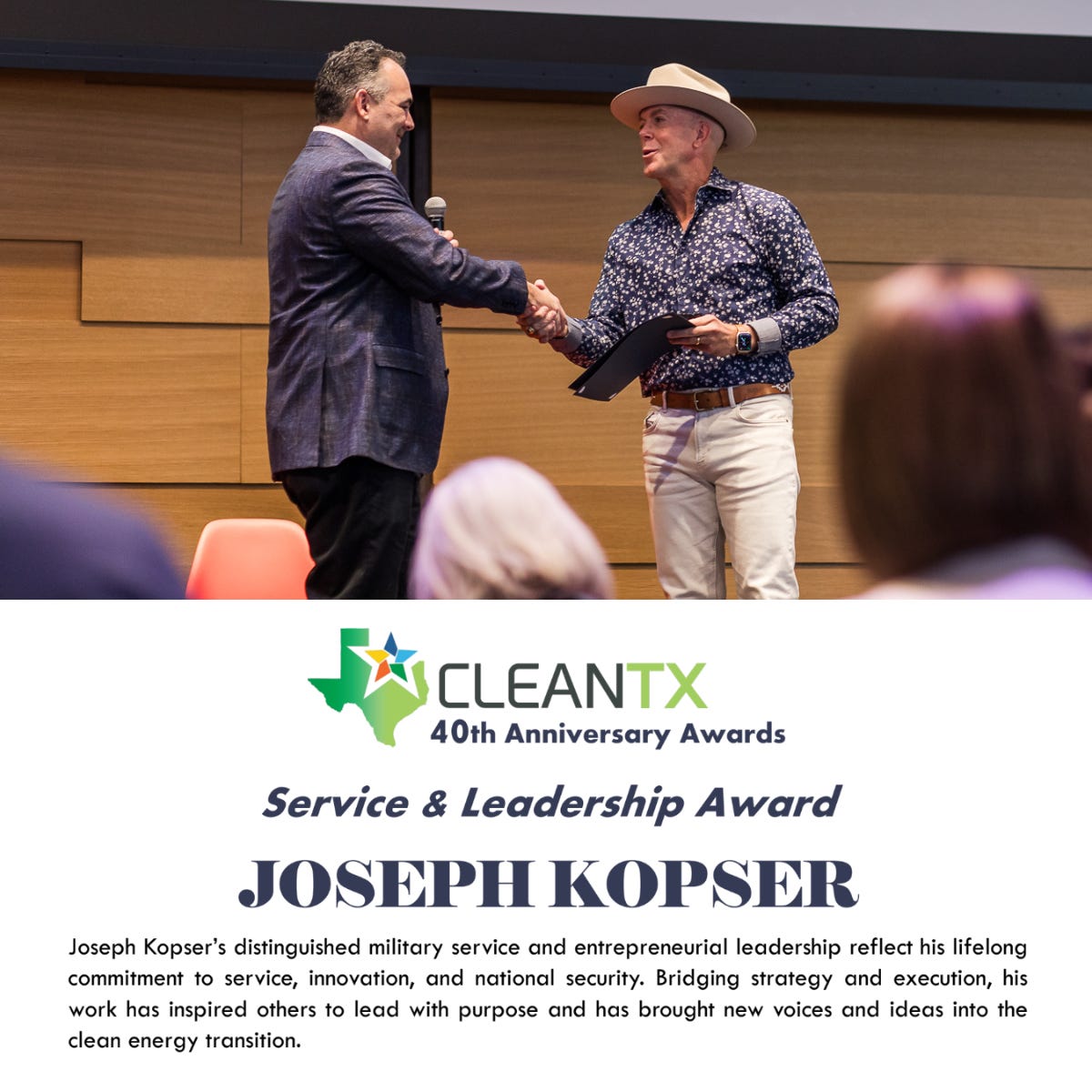
And most of all, it’ s a reflection of my commitment to make sure our warfighters have the best equipment and technology to make sure they are never in a fair fight. I want them all to come home safely to their families when their country sends them overseas.
As the U.S. strives to lead the world in artificial intelligence, the infrastructure behind it—massive data centers—requires unprecedented amounts of energy. These data centers are growing rapidly, and their energy demand is projected to more than double by 2030, potentially using over 8% of the nation’s total electricity. For a system this complex, we must align policy, infrastructure, and innovation. Texas has all the components: a wealth of energy resources, remote land, a competitive electricity market, and a spirit of entrepreneurship.
Texas: Where Energy Innovation Meets the AI Economy
Texas leads the country in solar, wind, natural gas, and is laying the groundwork for a nuclear renaissance. On any given day, solar now provides up to 25% of the state’s electricity during peak midday hours. Wind continues to perform strongly, particularly at night. Together, they’ve made renewables a central pillar of our grid. To stabilize their variability, we’ve added over 5.7 gigawatts of battery storage—a 4,100% increase since 2020. These batteries smooth out supply fluctuations and provide vital capacity during peak demand. Check out Doug Lewin’s Texas Energy and Power Newsletter on Substack for more information.

More importantly, we’re starting to see these technologies combine in powerful ways. In West Texas, a 1.2 GW data center campus is being built alongside one of the country’s largest solar farms and battery installations. In Pecos County, developers are integrating a natural gas plant, battery storage, solar, and a planned AI data center all on the same site. This colocation strategy isn’t just smart—it’s transformative. By placing energy production and consumption side-by-side, we increase efficiency, reduce transmission losses, and create new revenue models for developers and communities.
Even nuclear power is getting renewed attention. New projects featuring advanced reactors and microreactors are being considered for rural deployment, with a goal of pairing them with high-demand users like data centers. These reactors promise consistent, carbon-free baseload energy that can operate independently from grid volatility. If executed well, they will complement Texas’ existing assets and elevate our ability to deliver 24/7 clean power.
The future isn’t about one technology—it’s about integration. Across West Texas, developers are pairing solar, storage, and gas plants with data centers, creating self-sustaining ecosystems that blend energy production and consumption on the same site. It’s the same story with nuclear: small, modular reactors could anchor data centers and rural economies alike, bringing 24/7 carbon-free power where it’s needed most.
The reason this matters goes beyond kilowatts and gigawatts. What’s happening in Texas could serve as a model for the rest of the country. Our independent ERCOT grid allows us to move quickly and experiment with innovative market mechanisms. Developers know that in Texas, they can respond directly to demand without waiting on lengthy regulatory approvals. This agility is exactly what’s needed in an era when the energy transition and the digital revolution are colliding.
But it’s not just about speed—it’s about coordination. As a policy entrepreneur, I’ve spent my career trying to bring people together across silos. Whether it was founding RideScout after watching soldiers risk their lives delivering fuel, launching the Defense Energy Summit to connect military and clean-tech leaders, or working with CleanTX to promote bipartisan energy policy, my focus has always been on systems thinking. If we can align incentives, empower innovators, and engage communities, Texas can lead the nation in both energy security and technological progress.
Looking forward, we need smart investments in grid infrastructure, updated market rules that value flexibility, and support for a workforce trained in advanced energy and computing systems. This isn’t a red or blue issue—it’s an economic opportunity. Data centers don’t just need electricity; they need reliability. And Texas, with its mix of resources, policy tools, and entrepreneurial mindset, is ready to deliver.
This award is more than recognition—it’s a challenge. To keep bridging sectors that rarely talk to one another. To ensure the clean energy transition also strengthens our national security. And to keep working toward a Texas that powers not just the AI revolution, but a safer, smarter, and more sustainable future.
Thank you for being part of the USTomorrow community—together, we can turn this potential into reality.
Let me know what you’re seeing out there,
Joseph
Joseph Kopser
Co-Founder of USTomorrow
I encourage you to click here for more on Linkedin , X-Twitter, Instagram, Bluesky, Medium, and Facebook.
Glad to see CleanTX still going!
A very timely piece by @Doug Lewin : https://x.com/douglewinenergy/status/1984002491709845867?s=46&t=gPDEth3V3HbwN33ciUEM5g