


With all the talk about the new Pope, the Vice President’s return to Rome and religion being in the news so much recently, I wanted to highlight a great book that stays top of mine for me when people talk religion and politics. (Which I hope more people do!)
I want to recommend: The Kingdom, the Power, and the Glory by Tim Alberta. This book offers insight into the evolving role of the evangelical church and how its internal battles have influenced American politics.
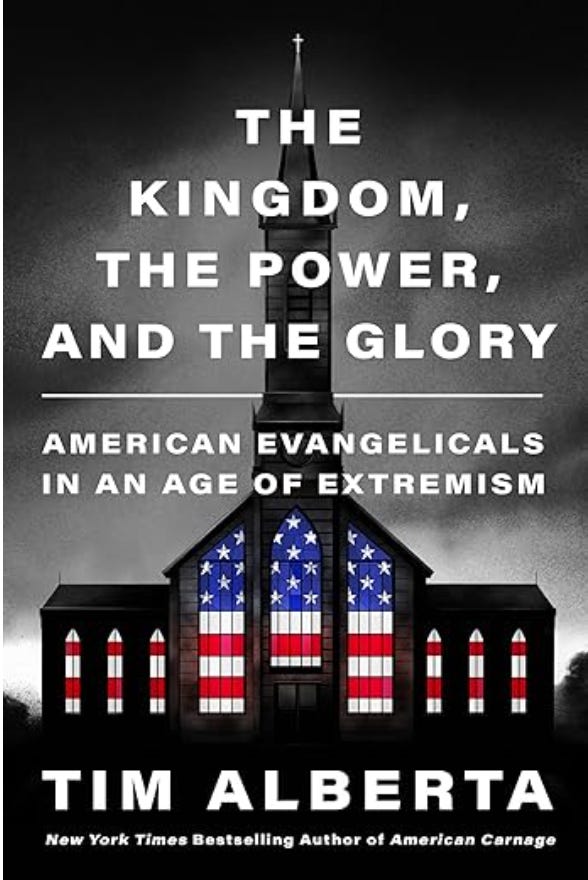
Understanding the Evangelical Movement
Alberta, himself a Pastors’ son and practicing Christian, provides a nuanced look at the modern evangelical movement through the experiences of pastors, congregations, and everyday believers. He explores how shifts in values and priorities have led to divisions within the church, which in turn reflect and contribute to the polarization we see in politics today.
You might recall I did a recent piece on how Democracy grows stronger when more Christians reflect Christ’s compassion—and when secular voices make space for faith in public life. It’s why I found the book so compelling.

A Mirror for Our Politics
For many conservative Christians, America has been seen as a special, divinely blessed nation. However, Alberta points out that this national pride has sometimes evolved into political/Christian nationalism. He traces key moments in recent history, such as the Trump presidency and the COVID-19 pandemic, to show how these events have deepened existing trends within the evangelical community.
Alberta aims to explore the complexities of how faith and politics have become intertwined, leaving readers to reflect on the future of both the church and the country.
In writing this post, I found a great interview between Tim Albert with fellow Pastor’s son, Jon Ward, before the book went to press. It’s a great discussion if you enjoy audio podcasts.

Final Thoughts
I believe The Kingdom, the Power, and the Glory is a valuable resource for understanding the broader cultural and political shifts we’re witnessing. It sheds light on the challenges facing the evangelical community while offering important context for the current political climate. I encourage you to read it and share your thoughts.
It might even help with a family member or neighbor where you both don't understand each other's political views when it comes to understanding why the country is still nearly 50-50.
What are you seeing out there?
PS– Bonus material: From Harvard-- “The latest from Which neighborhoods in America offer children the best chance to rise out of poverty? Professor Raj Chetty, Director of Opportunity Insights and a faculty affiliate of the Bloomberg Center for Cities, seeks to answer this question through the Opportunity Atlas, a dataset recently updated to show trends in economic mobility.
Using anonymous data from millions of Americans, the tool shows how opportunity varies within and across communities, how it is changing, and how it can inform solutions that improve children’s outcomes.”
You might recall from a previous post that where a person lives impacts not only their future but their identity, and therefore their politics.

Let me know what you’re seeing out there.
Joseph Kopser
Co-Founder of USTomorrow.us