


As you know, I’m running for office entering a primary on March 3rd, 2026.
Being back on the campaign trail has reminded me of something that still surprises me: many people don’t know when the 2026 primaries are held—and even fewer understand why primaries matter so much in today’s gerrymandered political landscape.
As we look ahead to the 2026 election cycle, there will be enormous attention on the November general election. It will feel like a national referendum, and turnout will be high.
But here’s the reality we don’t talk about enough: in much of Texas—and across the country—the November outcome is often decided months earlier, in the primary.
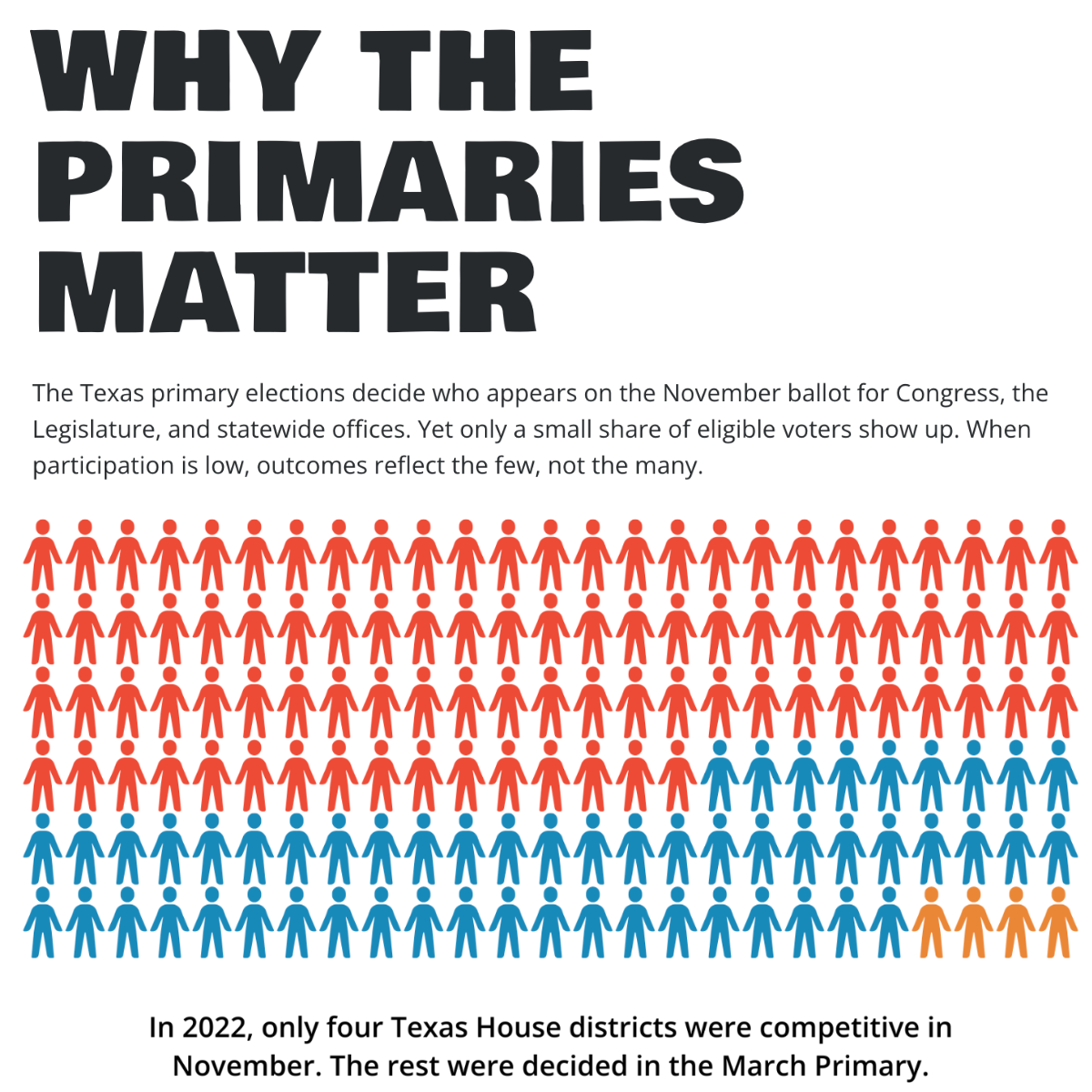
In heavily gerrymandered systems, the real competition happens in low-turnout primaries where a small slice of the electorate effectively chooses who gets elected. Shockingly, as Marjorie Clifton, co-founder of March Matters, points out, there is very little coordinated effort in Texas to expand primary turnout—even though primaries are where political power is most often decided.
Consider this: since 1998, Texas primary elections have decided all 27 statewide offices and 145 of the 150 legislative seats. That means primary turnout doesn’t just influence politics—it largely determines it.
March Matters exists to educate and empower all Texas voters to participate – not just a small, targeted 10%.
March Matters is a non-partisan, non-profit initiative helping people understand when primaries happen, why they matter, and how to vote. They do this by partnering with trusted institutions already at the center of Texans’ lives—employers, faith communities, and community organizations.
The message is intentionally simple and relatable:
March Matters to your grocery prices.
March Matters to people of faith.
March Matters to your healthcare access.
Organizations can use a free promotion toolkit, adapting the message to their own voice and brand. There are no endorsements, no candidates, and no legislation promoted—only clear, neutral information about the most consequential election in Texas.
The near-term goal is ambitious but achievable: turn out 250,000 additional primary voters in 2026, and grow from there.
The ask is straightforward. If you’re a super-networker, business leader, faith leader, grassroots organizer, or part of any community organization, March Matters invites you to use their free toolkit to help close one of the biggest gaps in our democracy: primary election participation where decisions are actually made.
Speaking of broken systems: A Simple Ask Before the Deadline
As the year closes, candidates are judged by fundraising deadlines that favor insiders and shift the burden onto everyday people who simply want to be heard.
I’m running because that system isn’t working—for working families, or for our kids’ future.
If you believe primaries should reflect communities, not political machines…
If you believe progress and justice go hand in hand…
And if you believe we can do better than the status quo—
I’m asking you to consider making a donation today, before the December 31st midnight deadline.
Every contribution helps show momentum, independence, and a commitment to building something better.
Six Signs Democracy Still Has a Pulse
Finally, to round out the year I wanted to share a recent piece from the Builders Movement.
Spend enough time online and it’s easy to believe everything is broken beyond repair.
But step back, and 2025 told a more hopeful story—one where people kept showing up, working together, and refusing to give in to permanent division.
The Builders Movement recently highlighted six developments that quietly restored their faith in democracy:
1. Peace Came Back Into View
After years of stalemate, diplomatic efforts around Gaza, Israel, Ukraine, and Russia hinted—however imperfectly—at de-escalation. Peace rarely arrives loudly. It arrives slowly, through persistence.
2. Bipartisan Work Still Happened
Despite the noise, lawmakers passed bipartisan legislation on addiction recovery, veteran support, disaster relief, and rural schools—proof that cooperation hasn’t disappeared, it’s just underreported.
3. Disasters Cut Through Politics
From wildfires in California to floods in Texas and tornadoes in St. Louis, people helped without asking party affiliation. In moments of crisis, humanity still leads.
4. Even Partisans Softened Their Tone
After political violence and tragedy, leaders across the spectrum called for civility. When those fueled by outrage begin questioning it, that matters.
5. Ordinary People Bridged Real Divides
In Builders’ Citizen Solutions sessions—including in Texas—participants with opposing views worked together on healthcare solutions and left realizing cooperation was possible.
6. Millions Chose to Be Builders
In 2025, the Builders Movement grew to more than 4 million people—a quiet majority choosing unity over outrage and problem-solving over point-scoring.
A Builderly Resolution for the Year Ahead
(Quoted in full, from Alex Buscemi’s post)
Hope isn’t passive. It’s a decision.
As we head into a new year, our resolution isn’t to pretend differences don’t exist or that hard problems will magically resolve themselves. It’s to take these moments as precedent.
People can work together.
Conversations can change minds.
Trust can be rebuilt.
Systems can improve—if citizens stay involved.Being a Builder doesn’t mean being endlessly optimistic. It means being stubbornly committed to the idea that we’re better off building together than tearing each other apart.
And if 2025 taught us anything, it’s that we’re far from alone in believing that.
A USTomorrow Takeaway for 2026
March Matters reminds us when democracy is decided.
Builders reminds us how democracy is sustained.
Neither is flashy. Both are essential.
If we want more trust, more competence, and institutions that actually deliver, participation can’t be episodic or performative. It has to be habitual—and it has to start where decisions are really made.
That work isn’t abstract.
It’s local.
It’s practical.
And it starts in March.
I wish you the very best and a Happy New Year in 2026!
Joseph Kopser
Co-Founder of USTomorrow
I encourage you to click here for more on Linkedin , X-Twitter, Instagram, Bluesky, Medium, and Facebook.