


I have a tradition about driving home on MoPac that has never once failed me. If the traffic looks bad, don’t get on it. Find somewhere to be for an hour and let the city sort itself out.
Last Tuesday the rule sent me to Deep Eddy Cabaret, which is where I learned that I had walked into a party. Austin Monthly was releasing its July/August issue, an ode to the city’s dive bars, and Deep Eddy was hosting. The bar turns 75 in November. Raymond and Mickey Hickman opened it in 1951, and they borrowed the name from the swimming hole up the road, which back in 1915 became the first swimming pool in the state of Texas.
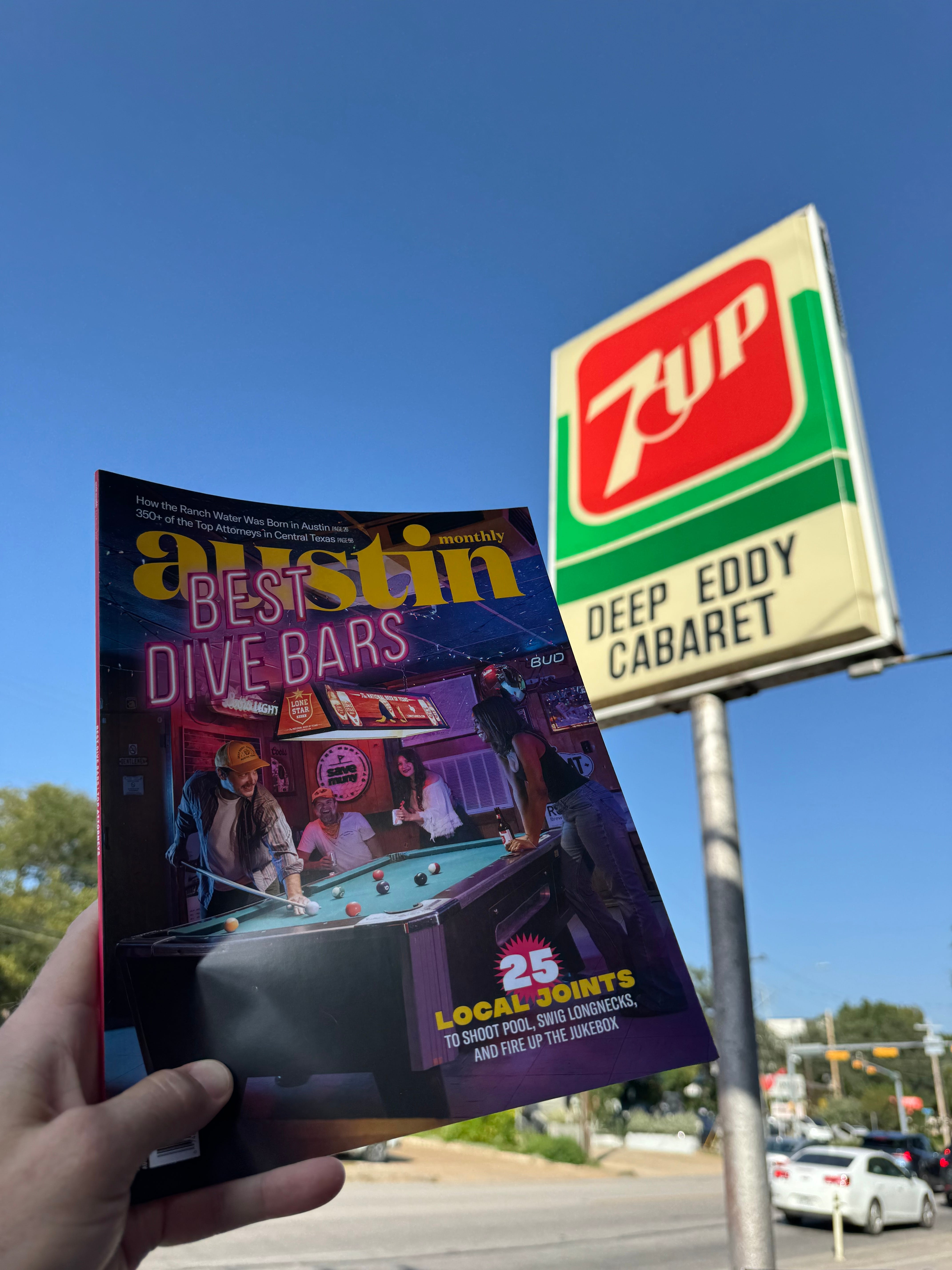
So there I am, not getting on MoPac, drinking a Miller High Life (a shout out to my late father), reading a magazine article about the room I’m standing in. It was also a cool moment that I got to meet Executive Editor Bryan C Parker and share that my first company RideScout made it into an Austin Monthly article back in 2013. (But I digress).
I’ve had three things rattling around my head for weeks. The midterms. A soccer team. A book. Standing in that bar, they finally clicked into the same idea.
The magazine got the important part right.
The feature runs 25 bars, written by Anthony Head and Bryan C. Parker, and it doesn’t waste much time trying to define a dive bar, which I appreciated. It settles on this: “good conversation, affordable drinks, and an absence of pretentiousness.”
Read that again and think about how few places are left that clear all three.
A dive bar has no membership. No dues, no committee, no pledge drive, no sign-up genius. It has opening hours and that’s the whole barrier to entry. You don’t have to believe anything to walk in. Some people find that kind of belonging at a church or a synagogue or a Rotary club, and they are important too. But a lot of people don’t join anything at all anymore, and the jukebox doesn’t ask.
The magazine put it in terms of college kids and hippie holdovers sharing the same room. I’d put it in terms that are less charming and more urgent. Dive bars are one of the last affordable places in America where you end up next to somebody who is nothing like you and stay there long enough to find out you’re wrong about them.
I’d put it in terms that are less charming and more urgent. Dive bars are one of the last affordable places in America where you end up next to somebody who is nothing like you and stay there long enough to find out you’re wrong about them— Joseph Kopser
Ninety-Nine days.
I heard that this week about the mid-term election. Ninety-nine days until November 3.
Everyone I talk to assumes this midterm will be another brawl. I’m not sure. What I’m picking up feels less like division and more like exhaustion. People aren’t fired up. They’re tired.
And here’s the thing about exhaustion in an election year. It doesn’t show up as anger. It shows up as an empty primary.
Look at what our own low-turnout primary produced in Texas. Ken Paxton beat John Cornyn in the May runoff and became the Republican nominee for Senate. Since then, reporters have found something remarkable in the campaign finance data. Of the nearly 100 donors who gave at least $50,000 to Cornyn’s campaign or its major supporting PACs this cycle, none appeared to have written a check directly to Paxton’s campaign or affiliated PACs after the runoff. Not a slow start. Reporting at Houston Public Media, KERA and Texas Standard all landed on the same finding, and Axios Austin got there a week earlier. Meanwhile the Democratic nominee, state Rep. James Talarico, has been outraising him roughly three to one.
I’m not making a prediction but I am hoping that decency will prevail over politics. I’ve voted for candidates in both parties and I’ll do it again as needed. My point is about the machinery, and it should bother you no matter which jersey you own.
A small number of people voted in March and May. That small number picked the nominee. Now a much larger number of people, including some of that party’s most committed funders, are looking at the result and quietly declining to participate. What I hope that means is that a larger number of Republicans I know and trust cannot stomach the idea of Ken Paxton as a US Senator. And this time, they might be willing to vote for a Democrat.
Which brings me to soccer, believe it or not.
We hosted a World Cup. Our men won Group D, beat Bosnia and Herzegovina 2-0, and then got taken apart 4-1 by Belgium in the Round of 16 on July 6 in Seattle. Home soil. Round of 16.
The griping started immediately, and most of it missed. The question isn’t why 26 guys underperformed. The question is why a country of 340 million with more athletes and more money than anyone can’t reliably produce a deeper pool.
The answer showed up in a wave of reporting this summer, and it isn’t complicated. Youth sports in America has become a paid product. Select teams, club fees, travel tournaments, private coaching, hotel rooms in another state most weekends. If your family has the money and one parent with a flexible calendar, your kid gets the experience and visibility needed. If not, your kid gets cut at eleven and never finds out what they had.
Now look at our women, who are the best in the world at almost everything they play. A big reason is that America decided decades ago to give girls a field, a coach, and a season, at a time when much of the world wouldn’t let their daughters play at all or wouldn’t pay for it if they did. We built an advantage on access. That’s the whole trick.
So the same country that proved access wins is currently pricing access out of reach of most kids in America today. (Don’t even get me started on the number of MAGA folks praising the talents of our first generation American players that would not be in the country if they had their way. I love sitting next to them in real life asking them to explain their way out of that logic. I enjoy every conversation like that!)
Robert Putnam warned us about this, and I’ve written about it before.
In Our Kids, Putnam laid out what happens when a community stops funding the things that mix children together. Cut the after-school program, cut the competitive team, cut the band, and you don’t just lose the activity. You lose the only structured hours in a kid’s week where they sit next to somebody from a different part of town.
That’s the loss nobody puts on a budget line. The rich kid and the poor kid stop knowing each other. The rural kid and the city kid stop knowing each other. Two kids at the same high school, in the same building, can now go four years without a single real conversation, because one of them is on the club team and the other one is working. Or worse.
We are running the same experiment on adults, and we’ve been running it longer. Fewer leagues. Fewer lodges. Fewer front porches. More sorting.
(I wrote more about Putnam’s work with Our Kids here below)

The book that tied it together.
Jim Collins published What to Make of a Life this past April, and it’s a departure from the business books that made him famous. It’s built on 34 people studied in matched pairs across ten years, two people with comparable starting conditions who arrive at radically different places. He’s after the pivotal moments, what he calls the cliffs, where a life turns.
Here’s the connection I couldn’t stop thinking about at the bar. Collins studies the moment a person meets a decision that changes everything. Putnam studies whether a kid ever gets close enough to such a moment to meet it at all.
Same method, matched pairs, pointed at two different halves of one question. Collins asks what you make of a life. Putnam asks who was in the room when you were deciding.
For most people, the honest answer is a coach, a teacher, a neighbor, somebody’s dad who ran the concession stand. People they’d never have met if the gym had been locked.
People will be what they can see. Collins thinks its important for Gen Z and Gen Alpha to work in the office and avoid the at-home experience. Putnam warned us already what happens when high school kids are not allowed to mix in person after school. The divisions fester and grow.
I like to say, “Friends at work make work more friendly.” It’s humanizing to get to know the people you work with. Just like organized sports and afterschool activities.
So here’s my ask for the next 99 days.
That’s what takes me back to Dive Bars and the role they play in society.
Go somewhere with a jukebox and no membership.
I wrote a piece last fall called “Save The Jerseys for Sports, Not Politics,” about a conversation with Jenifer Sarver, who ran against me for the same Congressional seat in a different primary. Watch that video and you genuinely cannot tell which of us was the Republican and which was the Democrat. The line that stuck with me from that whole exchange was hers, and it’s the thesis of everything above.
You can’t demonize people you’ve actually gotten to know.

Social media will not introduce you to your neighbor. It’ll show you the worst thing he wrote in 2019. A bar stool will introduce you to him, and it turns out he coaches a team, or he’s worried about his mother, or he agrees with you about four things out of six and you’d never have guessed which four.
Ninety-nine days. Go be in a room with somebody. Buy the next round. Leave the jersey in the car.
Then in November, do the boring thing and vote.
What’s your favorite dive bar?
One of mine’s on Lake Austin Boulevard and it’s about to turn 75. Tell me yours, and tell me about somebody you met in it who you’d never have met anywhere else. Hit reply. I read every one.
Joseph
Joseph Kopser
Co-Founder, USTomorrow.us
Joseph Kopser is a lifelong problem solver committed to building the teams needed to take on our toughest challenges. He is currently President of Grayline after he co-founded and served as CEO of RideScout, before it was acquired by Mercedes. He served in the U.S. Army for 20 years earning the Combat Action Badge, Army Ranger Tab and Bronze Star. He is a graduate of West Point with a BS in Aerospace Engineering and also received a Masters from the Harvard Kennedy School and former member of the Army Science Board. He was recognized as a White House Champion of Change for his efforts in Energy and Transportation as well as won the U.S. DOT Data Innovation Award. He co-authored the book, Catalyst, a book focused on helping teams adapt to change. He is the Chair of the Board of Advisors for the CleanTX, an economic development and professional association for energy innovation. In 2025, Joseph was selected for the Texas Business Hall of Fame Future Texas Business Legend Award. Joseph and his wife of 31 years, Amy, live in Austin and they are extremely proud of their three adult daughters living their best lives.
Great book my friend. Oz Tap House is my fave. Talarico wins.
Very insightful Joseph! As John McCain’s mother so famously said when he was running for President, “Sometimes you just have to hold your nose and vote”.