


You can’t turn on the TV or open the news right now without running into another story about AI and jobs. And the striking part is how differently people see it depending on their age and their stage in life.
Last month I wrote here that AI data centers are the new fracking.

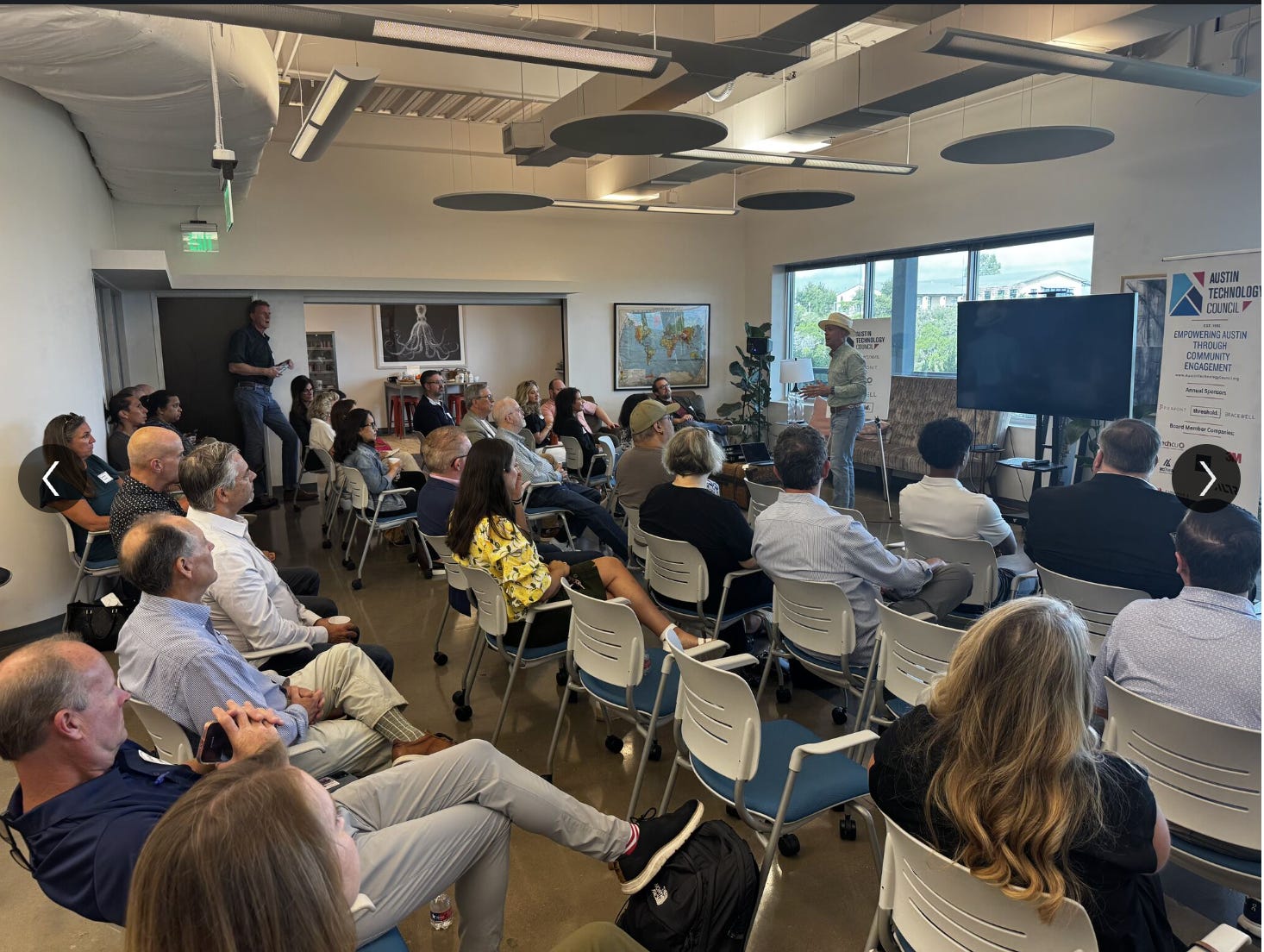
That piece got me invited to share some of my thinking with the Austin Technology Council.
This time my focus was less on the power grid and more on people. On workforce, on disruption, and on what the displacement of jobs means for the next generation. If you think are politics are bad now, wait until AI gets into the mix and makes it harder for us to seek truth.
But I did not go up there to sell doom and gloom. I told the room the truth about myself: I am a 99% AI optimist. I always leave that one percent open for the knuckleheads of the world who can still find a way to screw it up.
AI will displace jobs faster than a lot of people are ready for
That part is real, and I said so. But like almost every other step function in technology and innovation, the same wave that closes some doors kicks open whole new ones. New sectors get invented. New kinds of work appear that no previous generation could have imagined, and they turn out to be not just ways to make a living, but ways to support a family. I have watched it happen more than once in my own career. I believe it will happen again.
Then I walked the audience through a couple of ideas I have been chewing on.
We are going to need a “Trust Wall”
In a world where information is close to limitless, we are all about to face a never ending onslaught of outreach. Organizations are already using AI tools to scrape the web and figure out who you are, what you do, and what you like. Then they use it to write to you in a voice engineered to sound like your oldest friend.
Think about how many people already fall for scams over the phone or online today. Now hand the bad actors even better tools. It gets worse before it gets better.
The good news is that we get to build back. I call it the Trust Wall. It is a digital barrier we put up around ourselves to keep the flood of fake friendliness out. But a wall that only plays defense is not enough. If you are going to keep the bad actors out, you also need a way to decide who you let in.
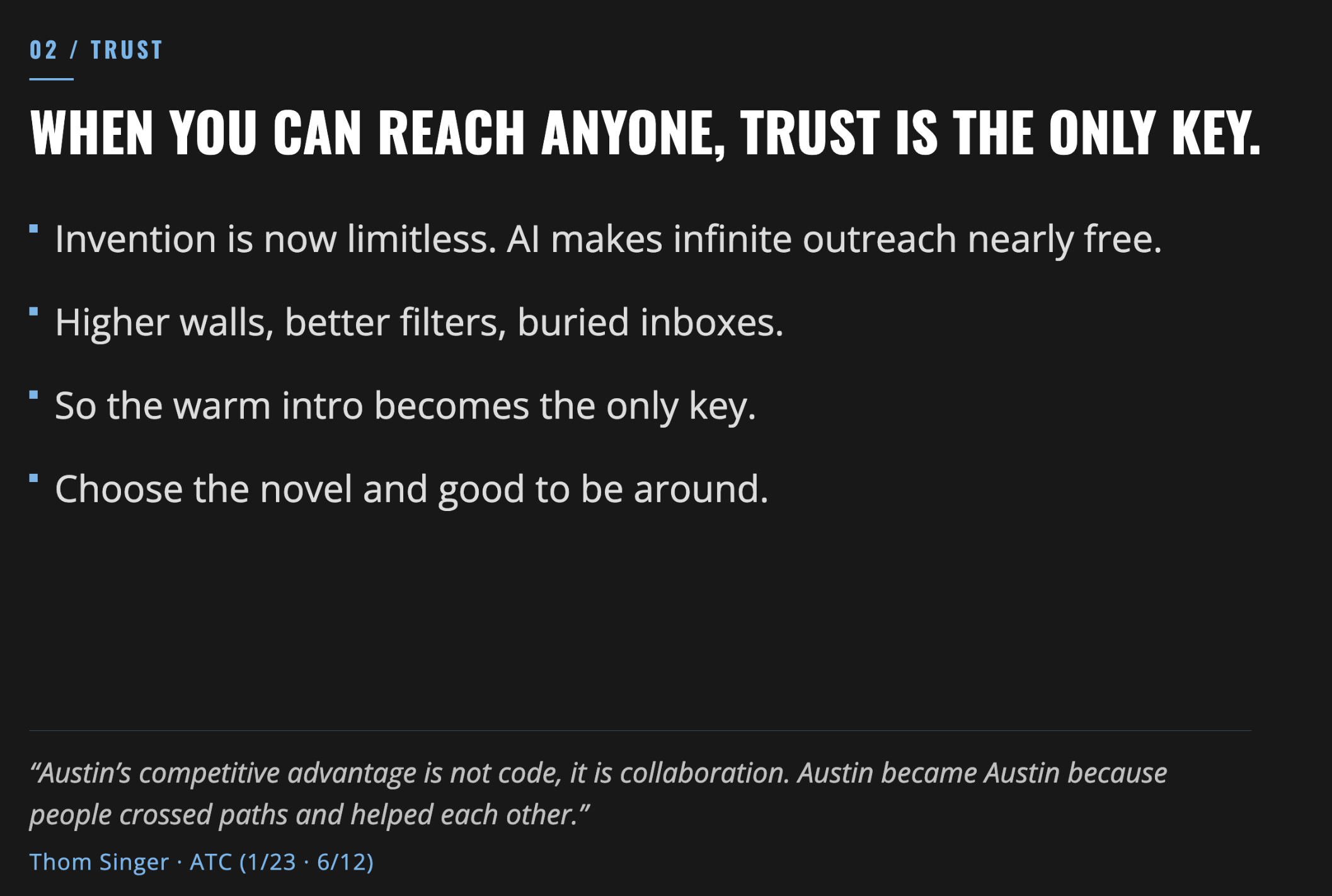
Here is the line I put on the screen at ATC. When you can reach anyone, trust is the only key. Invention is now limitless and AI makes infinite outreach nearly free, so the walls get higher, the filters get better, and inboxes get buried. In that world the warm introduction stops being a nicety and becomes the only key that still opens the door.
Your friends, family, and network are the ones who get over the wall
Here is the part I find hopeful. The people who get to breach your Trust Wall, who get waved over the top, are the ones you choose. Your friends. Your neighbors. Your family. Your real network.
And when they are building their own Trust Walls at the same time, the whole thing compounds. A network of people who vouch for each other is a network that nefarious folks have a much harder time getting through. This is the same social capital I write about constantly: the trust we build simply by being in each other’s corner is one of the most valuable, and most fragile, things we have. In the age of AI it stops being a nice-to-have and becomes your first line of defense.
My friend Thom Singer put it perfectly in one of his ATC newsletters:
“Austin’s competitive advantage is not code, it is collaboration. Austin became Austin because people crossed paths and helped each other.” Thom Singer, at the Austin Technology Council
That is a Trust Wall described from the other side. The city that got built on people helping people is exactly the city that knows the warm intro is the only key.
When anyone can do the work, employers get to be choosy
Now play that out. If the new tools mean that just about anyone can do the technical part, and two candidates show up with near identical credentials, then employers get to be a lot more selective about who they actually want on the team.
Gone are the days of keeping someone around only because they are a wizard with the technology and you feel like you cannot replace them. Technology is about to be able to replace just about anybody on the technical merits alone. That sounds ominous, but it hands us something better: permission to focus on the winners.
The winners live at two ends of the same spectrum
On one end are the genuinely creative. The bold, original thinkers who see the world in a way the machine cannot. AI, at its essence, is a compilation of all the world’s existing knowledge. If you can blaze a brand new trail, a trail that is not already in the training data, you have a very bright future.
On the other end are the people who are just plain good to be around. Pleasant, thoughtful, engaging, the kind of person others cannot say no to. If an employer is choosing among twelve candidates who are all armed with the same tools, they are going to pick the one they most want to work with.
That is the whole thing on a bumper sticker: choose the novel, and the good to be around. When the tools are equal, those are the two edges that still cut.
So who actually gets hurt by AI? The dull jerks.
If you follow that logic all the way down, the people who struggle most in the long run are the dull jerks of the world. Dull, meaning they bring nothing new to the table. Jerks, meaning they treat people poorly. Land in either bucket, and worse in both, and unless you are cushioned by generational wealth, this is going to be a hard world to make your way in.
The one skill I tell folks to work on
Afterward, people asked me the question I get most from parents and from high schoolers and college students themselves. In a world of AI, what is the single skill worth working on the most? Technology? Liberal arts? Something else?
My answer surprised them. It is not really a subject at all. It is making sure you don’t grow up to be a jerk.
The future of work in an AI world is genuinely unknown. But history has a few known knowns. Adaptive people who are willing to take a risk tend to land on their feet over the long haul. You will take a lot of swings that come up short. That is fine. Keep stepping back up to the plate, keep repeating the same mantra I gave my kids growing up, try to be happy, try to do the right thing, try to have a good thing to say, and rinse and repeat that over a lifetime, and you are going to do just fine.
Why I still hold onto that 1%
That is why I am a 99% AI optimist. For every tool we build, yes, some people will find ways to use it to cause harm. But more people will find ways to guard against that harm, and more still will find ways to use it for good. I have bet my career on that math, and I am not changing it now.
So let me turn it over to you. Where are you right now on the spectrum of AI optimism? Optimistic? Pessimistic? Still a question mark? Hit reply and tell me, I read every one.
And tell me what you are reading. The book I just finished that gives me the most cause for hope is Nexus by Yuval Noah Harari, which traces our information technologies all the way from the Stone Age to the age of AI. It is worth your summer. (Maybe not exactly beach reading, but it is for me!)
Take care,
Joseph
Joseph Kopser
Co-Founder, USTomorrow.us
P.S. Where do you fall on the optimism spectrum, and what’s on your nightstand? Leave a comment or hit reply. I read every one.
Joseph Kopser is a lifelong problem solver committed to building the teams needed to take on our toughest challenges. He is currently President of Grayline after he co-founded and served as CEO of RideScout, before it was acquired by Mercedes. He served in the U.S. Army for 20 years earning the Combat Action Badge, Army Ranger Tab and Bronze Star. He is a graduate of West Point with a BS in Aerospace Engineering and also received a Masters from the Harvard Kennedy School and former member of the Army Science Board. He was recognized as a White House Champion of Change for his efforts in Energy and Transportation as well as won the U.S. DOT Data Innovation Award. He co-authored the book, Catalyst, a book focused on helping teams adapt to change. He is the Chair of the Board of Advisors for the CleanTX, an economic development and professional association for energy innovation. In 2025, Joseph was selected for the Texas Business Hall of Fame Future Texas Business Legend Award. Joseph and his wife of 31 years, Amy, live in Austin and they are extremely proud of their three adult daughters living their best lives.
I wouldn't say I am pessimistic or optimistic...rather, pragmatic, which is basically what you described in your article. I look at most things through a practical lense: what makes sense, what's true, what's valuable. Figure out THOSE pieces of the picture and it's pretty hard to be a jerk.