


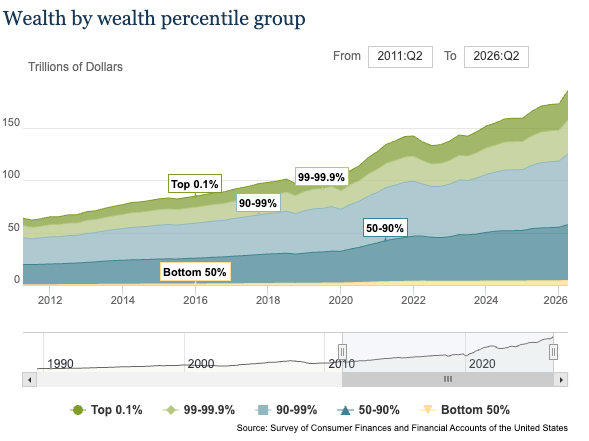
Here’s the number that made my jaw drop. Recent Federal Reserve data shows the bottom half of Americans own about 2 percent of all the wealth in the United States. Half the country. Two percent. (The top 1 percent, for comparison, holds about 32 percent.) That gap is going to shape how people feel about their country, especially right now.
The midterms are less than three weeks away, and there’s an undercurrent the polls may not be fully capturing. The war in Iran has dragged on since late February. Gas prices jumped 9.1 percent in September alone, and inflation climbed to 3.7 percent in the last major price report before the election.
Last week the President cut a deal with Putin to ease sanctions on Russian diesel, hoping to bring fuel prices down before November 3. Yes, Russia.
I wrote this summer about paying over $100 to fill my tank. It hasn’t gotten much better.
When half of us have almost nothing to show on paper for a lifetime of work, it gets hard to believe the institutions are working for you. So people tune out. Or they get angry. I see plenty of both.

So what do we do about it?
We do more to reduce the division, and we get more people to vote.
Only through voting will elected officials be more responsive. That’s not cynical, it’s just how the system works. Officials pay attention to the people who show up. When whole parts of the country stay home, they stop getting represented (and then they get more frustrated, and stay home again).
But people don’t vote in a system they don’t understand. Only through better civic education and awareness will more people be likely to vote. That’s where this starts.
I can still sing the jingle
As a child of the ‘70s and ‘80s, I grew up watching Schoolhouse Rock between Saturday morning cartoons. That’s how a lot of my generation learned how government was supposed to work. Three minutes at a time.
“I’m just a bill. Yes, I’m only a bill. And I’m sitting here on Capitol Hill.”
I can still sing it today. (Go ahead and try getting it out of your head now.)
The new Schoolhouse Rock
Luckily, there’s a new effort to bring back engaging civics education in short videos. A good friend and USTomorrow supporter shared his work with me this week on NutShell Videos. It’s brand new, they’ve made really effective, high-end videos that give a compelling overview of what’s going on. I’d encourage you to watch them, starting with the Wealth Distribution video. And very non-political, presenting the facts as the law currently allows it.
Wealth Distribution (3 minutes). Uncle Sam takes the field at “Stadium USA” next to a pile of 100 gold bars representing everything of value in America. Homes, cars, boats, stocks, businesses. Then he hands them out. The top 1 percent gets 31 bars. The next 9 percent gets 36. The next 40 percent gets 31. And the bottom half of the country gets two. The announcer looks around for a ref to throw a flag, and Uncle Sam points out that none of it is against the rules. The closing point is the one that stuck with me: this isn’t just about money, it’s about who gets the power to make the choices that shape our future.
Voting: It’s More Than Picking a President (4 minutes). Two young people notice an election happening in a year with no presidential race and ask what anyone could possibly be voting for. A referee turned “Policy Pete” walks them through it. Congress makes federal law and decides how federal tax money gets spent. The state sets the big rules for schools, highways and healthcare. Local officials handle property taxes, school boards and the pothole that almost ate somebody’s bike. Sometimes you vote on a policy instead of a person. It even explains what a midterm is (no pop quiz). And it lands on this: not voting is a decision too, because you’re leaving your future up to someone else.
Election Races: Follow the Money (5 minutes). An election as a car race. Red promises a lot of winning. Blue promises a lot of giving. Yellow shows up with an actual plan to fix unsafe bridges without growing the deficit, and $35 worth of fuel. Sponsors put their names on the cars likely to win, and one donor funds both of them because “I’m not betting on who wins. I’m investing in whoever does.” Then comes dark money, which you can see in the race even when you can’t see who supplied it. Perfectly legal. The most qualified driver falls behind because qualifications don’t buy ads. The takeaway is simple. Money doesn’t decide elections, voters do. So look past the paint and find out who’s paying for the fuel.
One more for your queue
Daniel Lubetzky (founder of KIND Snacks, and you may know him from Shark Tank) has a new weekly podcast called Build or Break, out of his Builders Movement. He talks with people from business, sports, entertainment and politics about why they took the risk and how they kept going when things started to break. His whole thing for years has been more builders and less us-versus-them, which is exactly what we need right now.
The episode with Matthew McConaughey is really good. He took 20 years of his worst reviews out to the desert and read them in one weekend. And they get into America’s 250th year, too. The entire podcast is really good.
Go vote
Election Day is November 3. Watch the videos. Send them to someone who’s thinking about sitting this one out. Then vote all the way down the ballot, because the potholes and the school boards are on there too.
You might recall my last newsletter on the importance of a free press and the controversy over barring CNN from the White House. Well, the press room discussion continues. The President’s pick for press secretary was fired after just five days on the job. (The White House says she’s “transitioning.”)

Hit reply and let me know what you’re seeing out there. I read every one.
Take care,
Joseph
Joseph Kopser
Co-Founder, USTomorrow.us
Joseph Kopser is a lifelong problem solver committed to building the teams needed to take on our toughest challenges. He is currently President of Grayline after he co-founded and served as CEO of RideScout, before it was acquired by Mercedes. He served in the U.S. Army for 20 years earning the Combat Action Badge, Army Ranger Tab and Bronze Star. He is a graduate of West Point with a BS in Aerospace Engineering and also received a Masters from the Harvard Kennedy School and former member of the Army Science Board. He was recognized as a White House Champion of Change for his efforts in Energy and Transportation as well as won the U.S. DOT Data Innovation Award. He co-authored the book, Catalyst, a book focused on helping teams adapt to change. He is the Chair of the Board of Advisors for the CleanTX, an economic development and professional association for energy innovation. In 2025, Joseph was selected for the Texas Business Hall of Fame Future Texas Business Legend Award. Joseph and his wife of 31 years, Amy, live in Austin and they are extremely proud of their three adult daughters living their best lives.
https://sharonlawrence.substack.com/p/elections-online-tools-for-voters
You need voter info? I put it all together for you. For all 50 states! I even include tips on how to avoid election scams plus polling place hours, ballot receipt deadlines, and much much more.
everything is available in pdf format for easy downloading & sharing.